Tuesday poem: Fingernails
October 15, 2024
Fingernails

They never stop questing outwards, these epiphytic plants,
soilless roots tonguing the air.  Mostly, we cut them into stubs,
mere bulbs awaiting final burial, asserting a sharp superiority.
Some men do allow them to snake their ways around and around,
until the hand becomes mere support for their rollercoaster ways.
Gone beyond decoration, the curling roundabout growths all indicate
each life's road and certain end. Some glue fake covers on each finger,
minute bright coffins jewelled with stones like Egyptian scarabs,
that once adorned the dead. But nails need never die. After host stops
they still grow, scraping coffins with cartilage, tusks of ivory feeling
for dirt long denied.  Some are fed finally on fire, and burn with sticks
and hair and skin, external teeth closing on the jerking meal of flame.
A few succeed, reach dark earth, and plant themselves, and grow to men,
who carry new nails on clever, thumb-opposed fleshy tools,
deaf to the breathless emergent growth that tips each handy finger.
It crawls out, from the fecund pinkness, unstoppable; the quick tipped
living pointer, small flat shelled snail, that whispers of unseen bones,
and death that never dies, but clasps us tight as skull holds mind.

PS Cottier

Last weekend I was part of a poetry roundtable as Conflux, a science fiction convention here in Canberra, and read this freaky poem which has obvious horror tropes. Delighted to find this illustration by JA Knapp at the wonderful Old Book Illustrations to go with it! I particularly like the mushrooms growing in the distance. I wouldn’t be eating them any time soon…
‘Fingernails’ first published in Chiaroscuro: Treatments of Light and Shade in Words (ChiZine), Canada, Volume 47, Week 2, April-June 2011.
A Very Blemished Evening
June 11, 2013
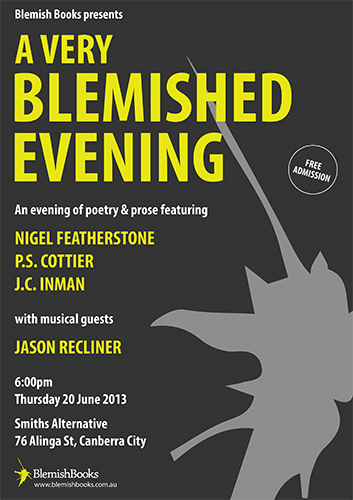
Canberrans!
Now is (almost) the time to come and hear novella-ist Nigel Featherstone, and poets JC Inman and P.S. Cottier. We’re all published by Blemish Books. Band Jason Recliner will open proceedings at Smiths Alternative on Thursday, 20th June at 6pm.
Smiths has a bar.
Smiths has a bar.
Smiths has a bar.
Voices, internal and external
August 17, 2009
I have been doing a few poetry readings lately, at a number of different venues. In some ways, the reading of poetry aloud strikes me as a strange practice. No doubt rhymes evolved to make things easier to remember where the written word did not exist, or was jealously guarded by a chosen few. But those days are long past, and rhyme has often been abandoned, or, if used, is no longer a substitute for literacy.
The performance poet or slammer lives and writes for the spoken (or shouted) word. This is not, in general, my favourite type of poetry. Many crude faults are hidden behind the energetic or frenetic delivery. I saw one particularly bad example a couple of years ago which inspired this piece:
Waste of a good microphone
A decade since I saw him, this performance poet,
and the act is still the same, ten years in the faking.
World’s oldest adolescent, wings flailing, flirty windmill
hoping to attract stray Quixotes of attention.
Under that boil of a hat (one small step from beret)
his chin now quivers in time to his shout, as he revs
through a thick tarmac of prose. He calls it a poem.
(It is poetry in the sense that Bathurst is ballet.)
Fascinated, I watch the skin wattle sway,
muscle-less metronome catching winds
of his own indignation; a crashing fleshy kite.
A one miss wonder, he raises his frantic voice
and chops the air with blunt inadequacy.
The words skim like fatty stones, drowning.
Such dumb slabs to whet a frolicsome pen.
P.S. Cottier
But the reading out loud of poems that were written to be read from the page is the phenomenon I am dealing with here. When I write, I tend to read the poetry back to myself in my head, rather than out loud. It is a delight to me to hear others appreciating the word-play and musical aspects of my poetry when I read it out loud to an audience. But my ‘ideal reader’ is definitely an individual, reading from the book at his or her own home (or library).
Nevertheless, I like to think I am quite a good reader, with a decent appreciation of the needs of the audience. Some poets, contra the performance poet, see, to think that a mangled, quiet delivery adds a certain piquancy to the words. IT DOESN”T. Or that reading twenty pages of angst-filled obscurely referenced screed to a non-academic audience is appropriate. IT ISN’T. This shows a lack of respect, and does poetry no good at all, cementing into place the brickheaded equation of poetry = boredom. At least most slam poetry keeps the audience awake.
Between Shout Mountain and the Slough of Mumble lies the pleasant Valley of Appropriateness. Let’s all set our compasses and go in search of that verdant realm.
 PS Cottier