Muse-sick
May 6, 2011

I am about to embark on a fortnight’s total immersion in music. Sounds like acoustic water-boarding, but it’s a matter of choice. The Canberra International Music Festival runs between May 11th and 22nd, and I’ve splurged on a gold pass, which means I can attend all 34 concerts, should I so choose.
I find that the ‘jet-lag’ caused by embarking on the long-distance haul triggers connections in my brain that otherwise lie dormant. That’s once I get past the lurking feelings of inadequacy that great music always creates. Sometimes I feel that poetry is music’s poor relation, being tied too much to meaning. But then another vodka kicks me past this, and the synapses stimulated (or created) by the baptism in sound can be put to good use, emphasising the noise that words make, and twisting meanings into improvised forms.
Here’s a little poem about the feeling that others (or Others Unseen) are somehow more perfectly creative. (Interestingly, I searched Bigstock for an illustration combining music and snails to go with the poem, and found the image above. It’s comforting, in a way, to know that someone else’s mind has been where mine has!):
Even snails
Peg loves looseness, envies river of sheet,
flowing down from plastic clench of beak.
Milk would carve itself into solidity, escape
sloppy white seascape into certainties of cheese.
Poet would be musician, shed sad bad husks of words,
sprout into airier art, so eary and so letterless.
Sliming through house-heavy dirt,
even snails may dream of wings.
P.S. Cottier
Update 11th May
Just returned from sitting in an exposed position on concrete on a wet piece of rubber listening to William Barton and an organist play some interesting music. (Barton’s own composition and some Philip Glass.) But I really couldn’t concentrate or enjoy the experience, as it was just too cold. There’s no way that concerts should be staged in Canberra at 7am at the end of Autumn. There’s a real martyrdom for music attitude amongst some of the attendees at the Canberra International Music Festival. I simply had to leave early as I felt I might get hypothermia. I obviously don’t have the right attitude. And the event was very difficult to locate for those of us who got there early, which added to my general festive spirit.
Unbelievable comment from one fellow attendee when I commented that I hoped the performance was not cancelled due to possible rain damage to the instruments: ‘Oh no, it’s only a didjeridu’. 40,000 years of culture belittled. Hats off to you, dickhead. (Although there’s no way I would have removed my hat due to possible frost-bite.)
Previously I saw William Barton as one of the musicians in a concert at the Fitters’ Workshop featuring Sculthorpe’s Requiem, another requiem by Tomas Luis de Victoria and a setting of ee cumming’s ‘I thank you God for most this amazing day’ by Eric Whitacre. I wasn’t too keen on the last one, perhaps because that poem is so near perfect that the music seemed, for once, to detract from its beauty.
The event was co-sponsored by the Spanish Embassy. A Spaniard (I think she was, anyway) pointed out that there were several red-backs nestling at the edge of the concrete of this old industrial building, including one enormous one. I agreed that it was better to leave them alone, rather than stir them up into possible vengeance (a pun about red-backs and bulls was stifled on my tongue). I found myself explaining how the really big ones are female. I hadn’t expected to become a junior David Attenborough at the concert, I must admit. No doubt she’ll have a story to tell back in Spain: (‘..and they have horrible spiders, even at musical venues…’)

100 stories for Queensland
April 30, 2011
What a year for disasters. New Zealand, Japan, the recent storms in the United States, and, of course, the catastrophic floods in Queensland. There are probably many more too, but these four are the ones I’m most familiar with, perhaps because they happened in developed countries, which tend to get more attention in the media. But wherever such events occur, the suffering is undeniably real. And to have a disaster in one’s own country means a certain responsibility to help in some way rests on those who were not affected.
I am very proud to have a tiny story called ‘Beating creativity’ (so flash, if you blink, you’ll miss it) in the book 100 stories for Queensland, which will raise funds for the Premier’s Flood appeal. The book will be launched on 3rd May, and will cost $19.99, and you should be able to order it through your local bookshop soon after that. Or you will be able to go here to find out how to order the book electonically, as a hard copy or an ebook. Here is some more information about the project, from the home site:

“One hundred beautiful stories. Our stories. When so much was lost or destroyed, this was created. That’s something that can never recede or wash away.” ~ Kate Eltham
CEO of The Queensland Writers Centre
100 STORIES FOR QUEENSLAND has something for everyone, from slice of life to science fiction, fantasy to romance, paranormal to literary fiction. Heart-warming, quirky, inspiring and funny the stories between these covers will lift readers to higher ground.
ISBN (Print): 978-0-9871126-2-0
ISBN (eBook): 978-0-9871126-3-7
Pages: 316
Dimensions: 229x152mm
RRP: A$19.99, US$19.99, ₤9.99, €9.99
UPDATE: There will be a slight delay with the hard copy. Best to go to the 100 stories link in the blogroll (or here) for further details. The hard copy book can now also be ordered from Amazon.
And then there’s Mars…
April 9, 2011

It’s fifty years since Yuri Gagarin went into space (April 12), following a few unfortunate animals who had no choice. No doubt about it, he was brave. There are many events happening worldwide for ‘Yuri’s Night’, go here for more info.
Here’s a little poem about him. This poem was previously published in The Mozzie (Queensland):
Gagarin’s death
Yuri Gagarin, first human being in space, died on a training flight in a MiG jet on 27 March 1968.
Some say it was the weather,
and others far too much fuel;
and of course, conspiracies
always have their murky place.
Personally, I believe it was
a simple swarm of birds.
Not envious, not teaching
a Soviet Icarus a thing or two.
I think they just came to see
a man who’d seen much more
than any stonechat who knows
Summer Siberia and Winter Japan.
At least you died in flight.
Some things just have to be.
P.S. Cottier
***
And then there’s Mars. When are we going to get there? Here’s another poem about space exploration, previously published in this very blog in 2009:
Dear NASA,
When we reach Mars, kicking up red dust,
walking against gusts like Marcel Marceau,
let’s not do what we did on the Moon,
forty leap and leap-less years ago.
Let us not plant any one nation’s flag,
like a toothpick through a lump of party cheese.
Might a woman set her feet first on the planet
so often connected with war? And please,
please, no one takes golf clubs, whether niblicks
putters, drivers or irons. Let Mars stay a place
untouched by sprees of futility, no heady sticks
to launch tiny white balls into circles of space.
Leave no junk; let the plains spread clearly.
Just a few thoughts from
yours, sincerely.
P.S. Cottier

On the buses
April 7, 2011

I wanna catch me some poesy...
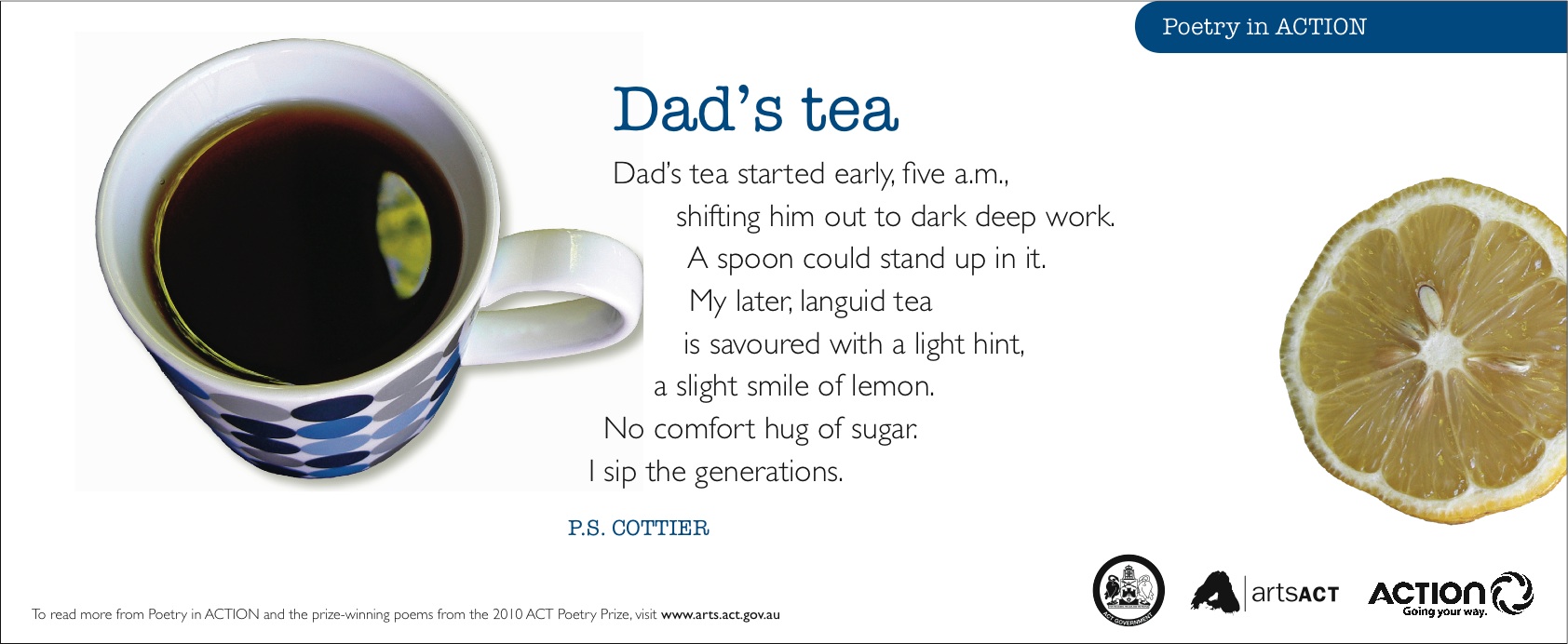
No, this is not a post about a hideous 1970s (?) British comedy called On the Buses, but about poetry recently published on the bus network in Canberra. The ACT government buys the advertising space on the buses for three months, so that people have something to look at that’s a little more interesting. I’m delighted that my poem will be seen by an estimated 10,000 people.
Here’s my poem called ‘Dad’s tea’, which is about (drumroll…) tea. Click to enlarge.
Bullying is forever (and beauty is truth)
March 22, 2011
Told by an idiot
There will always be one; thick glasses
squinting into unfriendly sun of the lovely,
ginger hair sprouting like the devil’s alfalfa
or yellow snakes of teeth dancing from mouth
to a crooked unheard tune. The sporty ones
will always tease, with their effortless jumps,
and flicks of grace, the laurel of the popular
a crown to their cruel, unearned joys.
And at the edge, noticing or feeling,
there’ll still be the quiet, lonely ones,
slipping under the radar with their
secret books and scuba words.
P.S. Cottier

 PS Cottier