Bat and ball and pen
May 31, 2011
There’s currently a great poetry competition on called the Cricket Poetry Award . For members of full member registered ICC countries only, of course, and if you don’t know what that means, you’re probably not going to be that interested in cricket. There’s a list of the countries on the site. For my American friends, cricket is a kind of baseball with rules. Lots of them.
I was short-listed for the prize a couple of years back with my poem ‘DIY’, about the way we act as famous sports-people when we play cricket, (or basket-ball, or football; Lionel Messi is a fallen angel, isn’t he? One who looks like an accountant after the Christmas party). The entry fee is $20, which may be a little steep for some cricket fanatics in developing countries such as India, Pakistan, Bangladesh or Sri Lanka. But the first (and only monetary) prize is $2000. That’s Australian dollars, which are currently worth more than the greenback. And short-listed poems are usually published in some form, although this is not in the rules (that word again).
The poetry can be about social cricket, and there is some information at the site about types of poetry. I enjoyed the opportunity to write about a sport that dominates Australia’s summers, particularly when we are playing England (who seem to have a team made up mostly of South Africans).
Here’s my poem from 2009.

D.I.Y.
In the backyard I was always David Gower.
I opted for an easy nonchalance,
the sweep you could weep for, the air cut
with a wooden knife of sudden elegance,
(when it could be bothered to dance the dance).
Truth is, I couldn’t bat at all, but that
is merely a fact. In the suburb of dreams,
I was graceful and quick and David Gower.
Why would anyone opt to be Dennis Lillee?
Grunt-powered, facial hair fallen to chest
where it grew into rain-forest, sweat-sprinkled.
There was nothing of the lily about him;
nothing quiet or lovely or sweet-scented
(although he always bowled as if he meant it).
Yet everyone else chose this dubious flower,
right-handed terror to my imaginary Gower.
P.S. Cottier
Death and the missus
May 19, 2011

mass grave
Death and the missus
Death is a doughnut; we lick his sprinkles every day.
We feel their shadows on our lips after they have buried
into our own grave of stomach. Burps are their ghosts,
rattling sonic chains. Perhaps we are the doughnuts,
dunked in Death’s ever morning coffee, as he chats
with Mrs Death. Mrs Death is a knitter, has been working
on the same cardigan these twice two million years,
needles clicking like clocks before there ever were clocks.
It’s a domestic thing, after all. One minute you’re watching
The Bill (you poor sad sod) and the next, you’re gardening
from below, totally rooted, rooted as. And Death sighs,
and has a little break at Donuts R Us, hands trembling
as he cups that endless drink. He gloves himself in sugar.
And then he gets back to it; the icing and the holes.
P.S. Cottier
First published in The Mozzie, Queensland.
Better than green: Beating OPEC
May 13, 2011
Here’s my suggestion for a new power source. I’ll be registering a patent soon.

must speak to my accountant...
Beating OPEC
Harnessing the energy of horror fans at cinemas
as dread zombies excavate warm bodies for dinners,
or vampires provide certain proof
that red and black fit neck in tooth;
this was my brilliant idea for a new power source.
Tingling fear explodes as the thick crimson sauce
splatters, or green mutant rats emerge from sewers.
Darker than oil, those cries of shivering viewers,
tinged with the delicious free energy of fear.
The true beauty was that they had no idea
that they generated watts with loud gusts of ‘No!’
and their howling winds of scream. I watched them grow,
my bank accounts, fed on those quivering masses
whose renewable angst was cheaper than gases.
Alas! Times changed, and romantic comedy smirks
where once deep slash movies bled. It certainly irks
to see the dark side fade out and my cash-flow cease,
and our total reliance on imported dear grease.
P.S. Cottier
Muse-sick
May 6, 2011

I am about to embark on a fortnight’s total immersion in music. Sounds like acoustic water-boarding, but it’s a matter of choice. The Canberra International Music Festival runs between May 11th and 22nd, and I’ve splurged on a gold pass, which means I can attend all 34 concerts, should I so choose.
I find that the ‘jet-lag’ caused by embarking on the long-distance haul triggers connections in my brain that otherwise lie dormant. That’s once I get past the lurking feelings of inadequacy that great music always creates. Sometimes I feel that poetry is music’s poor relation, being tied too much to meaning. But then another vodka kicks me past this, and the synapses stimulated (or created) by the baptism in sound can be put to good use, emphasising the noise that words make, and twisting meanings into improvised forms.
Here’s a little poem about the feeling that others (or Others Unseen) are somehow more perfectly creative. (Interestingly, I searched Bigstock for an illustration combining music and snails to go with the poem, and found the image above. It’s comforting, in a way, to know that someone else’s mind has been where mine has!):
Even snails
Peg loves looseness, envies river of sheet,
flowing down from plastic clench of beak.
Milk would carve itself into solidity, escape
sloppy white seascape into certainties of cheese.
Poet would be musician, shed sad bad husks of words,
sprout into airier art, so eary and so letterless.
Sliming through house-heavy dirt,
even snails may dream of wings.
P.S. Cottier
Update 11th May
Just returned from sitting in an exposed position on concrete on a wet piece of rubber listening to William Barton and an organist play some interesting music. (Barton’s own composition and some Philip Glass.) But I really couldn’t concentrate or enjoy the experience, as it was just too cold. There’s no way that concerts should be staged in Canberra at 7am at the end of Autumn. There’s a real martyrdom for music attitude amongst some of the attendees at the Canberra International Music Festival. I simply had to leave early as I felt I might get hypothermia. I obviously don’t have the right attitude. And the event was very difficult to locate for those of us who got there early, which added to my general festive spirit.
Unbelievable comment from one fellow attendee when I commented that I hoped the performance was not cancelled due to possible rain damage to the instruments: ‘Oh no, it’s only a didjeridu’. 40,000 years of culture belittled. Hats off to you, dickhead. (Although there’s no way I would have removed my hat due to possible frost-bite.)
Previously I saw William Barton as one of the musicians in a concert at the Fitters’ Workshop featuring Sculthorpe’s Requiem, another requiem by Tomas Luis de Victoria and a setting of ee cumming’s ‘I thank you God for most this amazing day’ by Eric Whitacre. I wasn’t too keen on the last one, perhaps because that poem is so near perfect that the music seemed, for once, to detract from its beauty.
The event was co-sponsored by the Spanish Embassy. A Spaniard (I think she was, anyway) pointed out that there were several red-backs nestling at the edge of the concrete of this old industrial building, including one enormous one. I agreed that it was better to leave them alone, rather than stir them up into possible vengeance (a pun about red-backs and bulls was stifled on my tongue). I found myself explaining how the really big ones are female. I hadn’t expected to become a junior David Attenborough at the concert, I must admit. No doubt she’ll have a story to tell back in Spain: (‘..and they have horrible spiders, even at musical venues…’)

100 stories for Queensland
April 30, 2011
What a year for disasters. New Zealand, Japan, the recent storms in the United States, and, of course, the catastrophic floods in Queensland. There are probably many more too, but these four are the ones I’m most familiar with, perhaps because they happened in developed countries, which tend to get more attention in the media. But wherever such events occur, the suffering is undeniably real. And to have a disaster in one’s own country means a certain responsibility to help in some way rests on those who were not affected.
I am very proud to have a tiny story called ‘Beating creativity’ (so flash, if you blink, you’ll miss it) in the book 100 stories for Queensland, which will raise funds for the Premier’s Flood appeal. The book will be launched on 3rd May, and will cost $19.99, and you should be able to order it through your local bookshop soon after that. Or you will be able to go here to find out how to order the book electonically, as a hard copy or an ebook. Here is some more information about the project, from the home site:
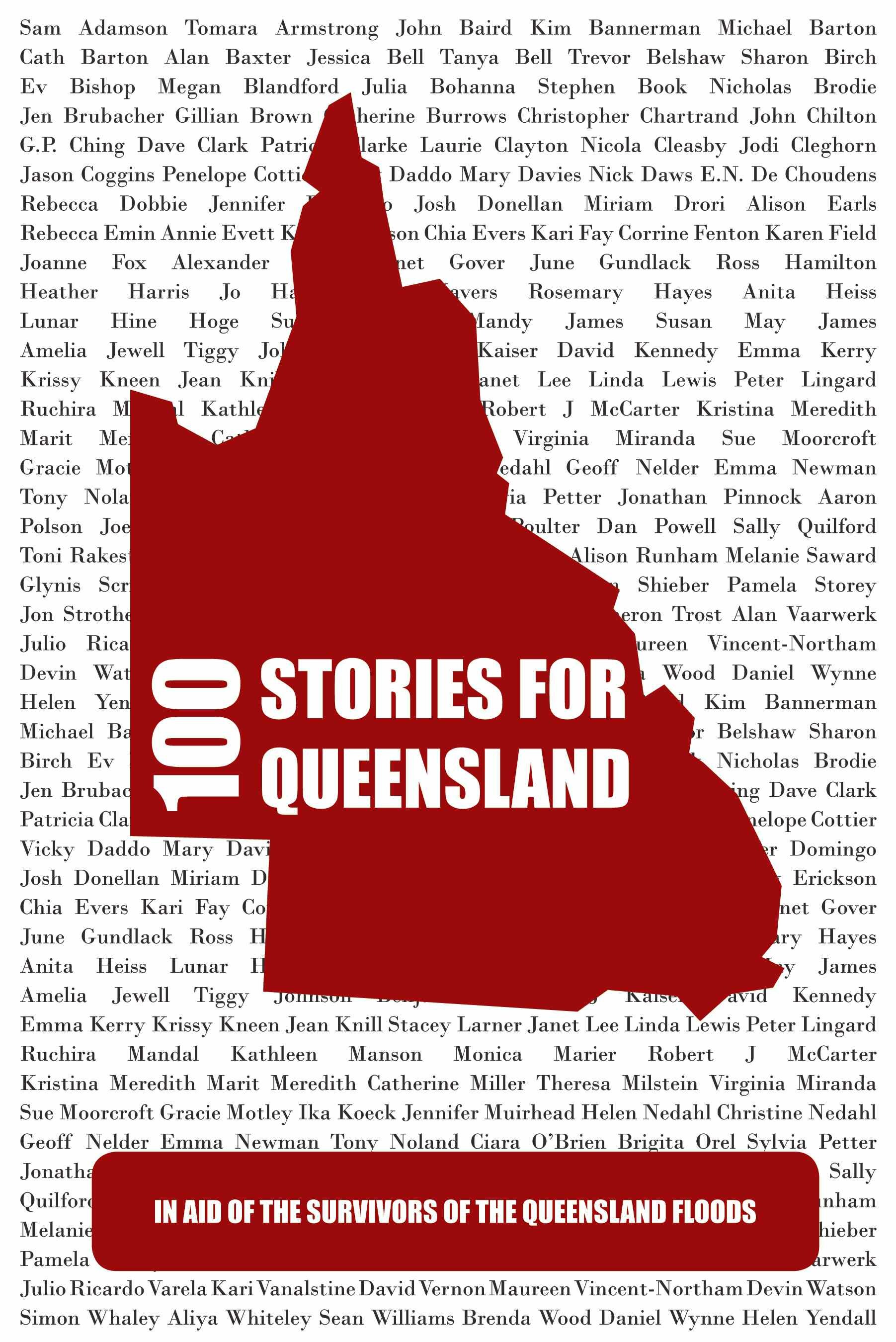
“One hundred beautiful stories. Our stories. When so much was lost or destroyed, this was created. That’s something that can never recede or wash away.” ~ Kate Eltham
CEO of The Queensland Writers Centre
100 STORIES FOR QUEENSLAND has something for everyone, from slice of life to science fiction, fantasy to romance, paranormal to literary fiction. Heart-warming, quirky, inspiring and funny the stories between these covers will lift readers to higher ground.
ISBN (Print): 978-0-9871126-2-0
ISBN (eBook): 978-0-9871126-3-7
Pages: 316
Dimensions: 229x152mm
RRP: A$19.99, US$19.99, ₤9.99, €9.99
UPDATE: There will be a slight delay with the hard copy. Best to go to the 100 stories link in the blogroll (or here) for further details. The hard copy book can now also be ordered from Amazon.
 PS Cottier