Not a rose by any prickly name at all
July 11, 2011

Cactus
Spiky camel hump, buried in sand.
Alien artichoke, Martian’s lunch.
I’m told to admire your
‘architectural qualities’. As if
we build houses of needles,
like one of those three little pigs
gone crazy, his brain curling,
dizzy, to match pale gimlet tail.
What huffing
fire-mouthed wolf-dragon
could blow you down?
Crooked eyes only, crave cacti.
Yet, every few years, you explode
into a neon gown of Brazilian hues
pulsating, pink or gold, as at Mardi Gras.
When poor become princes,
and thin desert blooms.
P.S. Cottier
Just published in The Mozzie, Queensland
Exporting pain
June 22, 2011
I wrote this poem about three years ago, and it seems like a good time to post it here. There is a push in Australia to ban live exports of sheep and cattle to countries where Australia has no real control over the conditions in which they are slaughtered (i.e. everywhere else but here). This is truly a horrible industry; not just because of the methods of slaughter often being unregulated but because of the long confinement that any trip from Australia necessarily involves. Here is a link to one of the sites pushing to have the trade banned.
It was quite predictable that there would be an outburst of stories featuring ‘honest Aussie farmers’ whose living is being threatened by ‘animal activists’. It’s unfortunate if anyone is really hurt financially, but it’s simply unacceptable that we are raising animals that are then being being tortured to death once exported. Kill the animals here, under proper religious supervision where necessary, and don’t turn a conveniently blind eye to the suffering of sentient creatures. I am a vegetarian, but there is no neutrality on this issue. Many meat-eaters have also been appalled to learn of the treatment of cattle in some foreign slaughter-houses, and the response to recently released video of conditions in some Indonesian abattoirs has reached far beyond the usual groups of animal rights supporters.
Any method of killing animals causes suffering, but this must be minimised, if people insist on eating them. The test for whether an industry is humane is ‘how would people feel if it was thousands of dogs being exported and killed like this?’ Imagine filling a container vessel with dogs and shipping them to, say, China to face a slow and painful death. What’s the difference with sheep and cattle? Oh, yes, that’s right. They’re not ‘pets’. Just animals. Delightfully logical. Enough rant, here’s the poem.
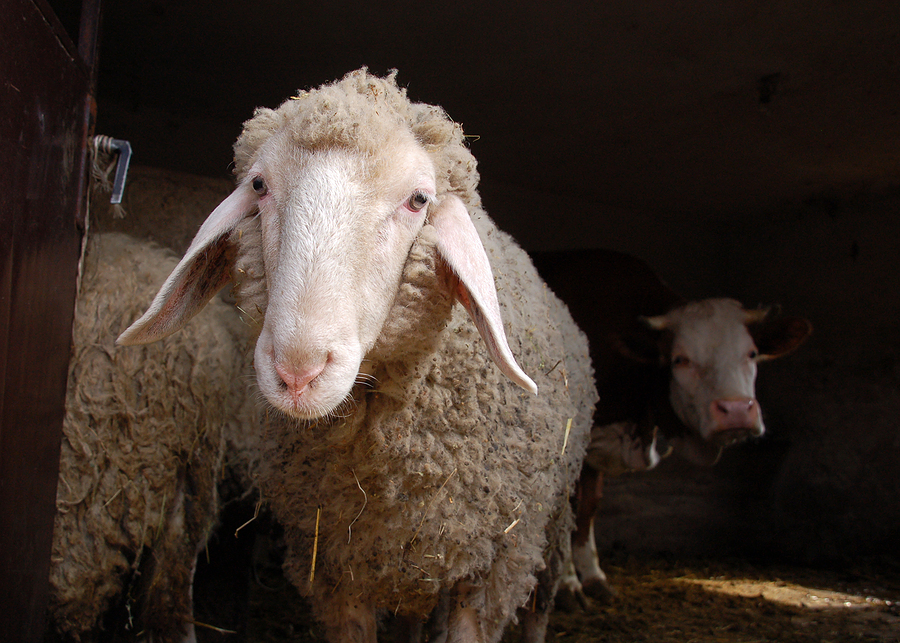
Global farms
Stock cubes
are sent to sea, flavoursome squares
of mutton flesh and bone, seasoning,
woolly sardines.
Between pasture and knife
the blue stretches, and the yellow,
as rivers soak downwards,
contained in time.
No truck of guilt to turn from,
met on sudden road. Squalor
bleats over dollar’s equator,
safely unseen.
P.S. Cottier
10 words, 2 days and a flock
June 17, 2011
I recently competed in an interesting competition run by a Canadian journal, Contemporary Verse 2. They give a list of ten words, and punters (who must have pre-registered) have two days to create a poem which contains every word. I sometimes like doing this type of thing as it stops me from falling in a rut, and if the result is less than wonderful, it doesn’t really matter.
I was very pleased to receive an honourable mention, particularly as I found myself writing about cockatoos; hardly something that the average Canadian would see stripping the bark from maple trees on a daily basis, or resting on the antlers of moose. Actually I know that Canada, like Australia, is overwhelmingly urban, so please excuse my tired and narrow stereotypes. (Is there such a thing as a vibrant and broad stereotype?) Here in Canberra cockatoos are as common as sparrows. If not commoner, which is remarkable given how many foreign birds have been released in this country over the past 200 years.
I won’t put the poem up here, as I can’t remember if I granted exclusive e-rights for a time to CV2 (probably not) but here is a link to the poem about cockatoos, imaginatively entitled ‘Cockatoos‘.

Muse with beak
Reading the other poems is fascinating; they are so good that I forgot that they had to contain the magic ten words. And the other poems were mostly urban.
Really urban, not Canberra urban.
Ghosts in slip
June 7, 2011
Further to my last post (now that sounds lawyerly!) here is another poem about cricket which was highly commended in the Adult Poetry section of the Kernewek Lowender Writers Event 2011. That’s an event celebrating Cornish culture in South Australia. I’m not Cornish, and I don’t know if cricket is popular in Cornwall, but here’s the poem, which actually rhymes. It was a pleasure to try something different in form (and tone) from my usual palette (aka bag of tricks). I wanted to try to write something almost like a ballad, and although it’s not perhaps my best work, there are images in it that I like.

Above the river-flats
That night I fell asleep after my customary ‘one or two’,
(which somehow numbered three, or four, or more than just a few)
and I awoke at half-past-nothing to the thump of ball on bat,
so I rolled over to watch the cricket ground, above the river-flats.
Cricketers wear whites, it’s true, but these glowed like a full moon,
and no-one had to run, for the players floated like balloons.
Above the grass they hovered like angels, or at least anaemic owls,
and something had muted their grunts and usual sporting growls.
‘Howzat?’ was quietly asked and somehow that old appeal,
sounded like Hamlet’s queries when he ponders if he’ll
be or end it all with a sudden bodkin that is bare,
and I wished I hadn’t laid my swag down, just exactly there.
The ghostly game played itself out, as all games must do,
and I lay and watched the players fade, and felt the showery dew.
Then I raised myself, and shook myself, like a dog come from a dam,
but knew that this attempt to forget was a feeble, wishful sham.
At the pub, later that day (and who wouldn’t need a beer
having watched ethereal cricketers for what seemed like a year?)
I raised the topic of the sports-ground, and what teams use that green,
all casual and circumspect with no mention of the scene.
‘There’s no teams play there no more’, my informant said.
‘All the young blokes have moved away, and the old ones are dead.
I was the greenkeeper, and I still keep it all mowed flat and nice,
but no-one uses it, ‘cept wombats. And the bloody mice.’
The truth tingled on the edges of my beer-loosened tongue,
to tell that immortal cricketers still sent the ball down, and swung
an elegant bat in a strange, beautiful moon-lit ritual,
but such a tale would mark me as a liar quite habitual;
So I shut my mouth, then opened it, and swallowed down my tale,
with the comforting blanket of my pension-purchased ale.
But each night now, as the visions toss and smash and frolic,
they are applauded with enthusiasm not entirely alcoholic.
For a man remembers many things, though he may forget more,
and I recall my own lost days, as I keep the spirits’ score,
before I left my home and love, when I played a different game.
And the exercise of the ghost-team now warms my tired cold frame.
P.S. Cottier
Bat and ball and pen
May 31, 2011
There’s currently a great poetry competition on called the Cricket Poetry Award . For members of full member registered ICC countries only, of course, and if you don’t know what that means, you’re probably not going to be that interested in cricket. There’s a list of the countries on the site. For my American friends, cricket is a kind of baseball with rules. Lots of them.
I was short-listed for the prize a couple of years back with my poem ‘DIY’, about the way we act as famous sports-people when we play cricket, (or basket-ball, or football; Lionel Messi is a fallen angel, isn’t he? One who looks like an accountant after the Christmas party). The entry fee is $20, which may be a little steep for some cricket fanatics in developing countries such as India, Pakistan, Bangladesh or Sri Lanka. But the first (and only monetary) prize is $2000. That’s Australian dollars, which are currently worth more than the greenback. And short-listed poems are usually published in some form, although this is not in the rules (that word again).
The poetry can be about social cricket, and there is some information at the site about types of poetry. I enjoyed the opportunity to write about a sport that dominates Australia’s summers, particularly when we are playing England (who seem to have a team made up mostly of South Africans).
Here’s my poem from 2009.

D.I.Y.
In the backyard I was always David Gower.
I opted for an easy nonchalance,
the sweep you could weep for, the air cut
with a wooden knife of sudden elegance,
(when it could be bothered to dance the dance).
Truth is, I couldn’t bat at all, but that
is merely a fact. In the suburb of dreams,
I was graceful and quick and David Gower.
Why would anyone opt to be Dennis Lillee?
Grunt-powered, facial hair fallen to chest
where it grew into rain-forest, sweat-sprinkled.
There was nothing of the lily about him;
nothing quiet or lovely or sweet-scented
(although he always bowled as if he meant it).
Yet everyone else chose this dubious flower,
right-handed terror to my imaginary Gower.
P.S. Cottier
 PS Cottier