Tuesday poem: Crying over spilt light
August 3, 2015
Crying over spilt light
About one-fifth of the world’s population can no longer detect the Milky Way with the naked eye due to light pollution. (Reported in Cosmos magazine, August/September 2009.)
Obesity of light blankets black,
clogs the arteries of recognition.
Blindness comes from the stroke
of too easy ignition; the fatty candle
of conjoined cities chokes imagination.
No matter; search the lost skies
by screen’s unblinking gaze,
and rediscover what Neanderthals
once mind-wandered quite for free.
Erasure of night by carrion globe,
pecking out eyes of speculation.
P.S. Cottier

I wrote this one back in 2009, and it was published in The Specusphere. I thought I would republish it as this year is the International Year of Light.
It struck me as ironic that the light we use to free ourselves from darkness in fact blinds us to the stars.
Have other poets have been writing about light?
Read the works of the other Tuesday Poets around the world by pressing here.
Tuesday poem: Is it a haiku?
July 20, 2015
winter strawberries
nipples in snow
limacine dreams
P.S. Cottier

I was tossing up whether to have an image of a slug or a strawberry. Looks like I opted for perky and nice with this Deborah Griscom Passmore painting of a type of strawberry called Parker Earle. Planted in the glorious field we call Public Domain.
Don’t think about that wee poem too much, or rather unpleasant images may occur. By the way, there is no shame in having to look up the word ‘limacine’, which is not a kind of expensive car. I trolled around for ages before I found ‘as ovine is to sheep, X is to slug’. And the word is perfect, I think.
Being a poet is a tough job, but someone has to do it.
Read the works of the other Tuesday Poets around the world by pressing here.
The asparagus fields of Peru are visible from space
1.
Little green rockets
counting down pushing up
tips pierce the moon
2.
Ballistic veggies
spears thrown up to satelleyes
sparrowgrass has landed
3.
Green fingers reaching out
Romero horror film
Night of the single crop
P.S. Cottier
The Victorians sometimes referred to asparagus as sparrowgrass:
“‘It’s a stew of tripe,’ said the landlord smacking his lips, ‘and cow-heel,’ smacking them again, ‘and bacon,’ smacking them once more, ‘and steak,’ smacking them for the fourth time, ‘and peas, cauliflowers, new potatoes, and sparrow-grass, all working up together in one delicious gravy.'”
(Dickens The Old Curiosity Shop Chapter 18)

My brain being what it is, I now picture thousands of guinea pigs lost in the vast fields of asparagus…pretty fat guinea pigs.
Whether there is any other poetry of an eco-poetic slant at Tuesday Poem this week, I know not. Read the works of the other Tuesday Poets around the world by pressing here.
photo by Muffet (cc licence attribution generic 2.0 Wikimedia Commons)
Tuesday poem: Winter in Canberra
June 29, 2015
Winter in Canberra
Wet paper mushrooms
thick crop on nature strips
Chronicles sprouting
P.S. Cottier

The Chronicle is a free newspaper distributed to, I believe, every house in Canberra. They are thrown onto nature strips (the Australian name for the grassy area between footpath and road) and there many of them stay. In winter, the plastic wrapping your Chronicle cannot keep out all the water from frost, so they end up as delightful parcels of yellowed, soggy paper. The one above has not yet reached full mushroom.
Some people end up with months of Chronicles covering the grass outside their home. Talk about first world unsightliness! I saw one man, driven mad by the abundant crop his lazy neighbour had grown, throwing them from their nature strip into their driveway, so they would not be able to ignore them any more. He was genuinely angry.
Meanwhile, in the real world…I hear there are places where free newspapers are not distributed! But surely that is just a rumour.

Here I am listening to Judith Crispin say nice things before my reading at Manning Clark House. Despite the photo, the space was packed. There were as many people as the average Canberra nature strip has Chronicles, but they were a lot less soggy. In most cases.
The reading went well; I tried out a lot of new material and I am becoming more confident. Mark Tredinnick was also seemed happy after his reading.
Now I am off to throw around a few newspapers.
Read the works of the other Tuesday Poets around the world by pressing here.
Belated Tuesday poem: (haiku)
June 24, 2015
The scant electric tree
sheds a furred question —
let the answer comfort
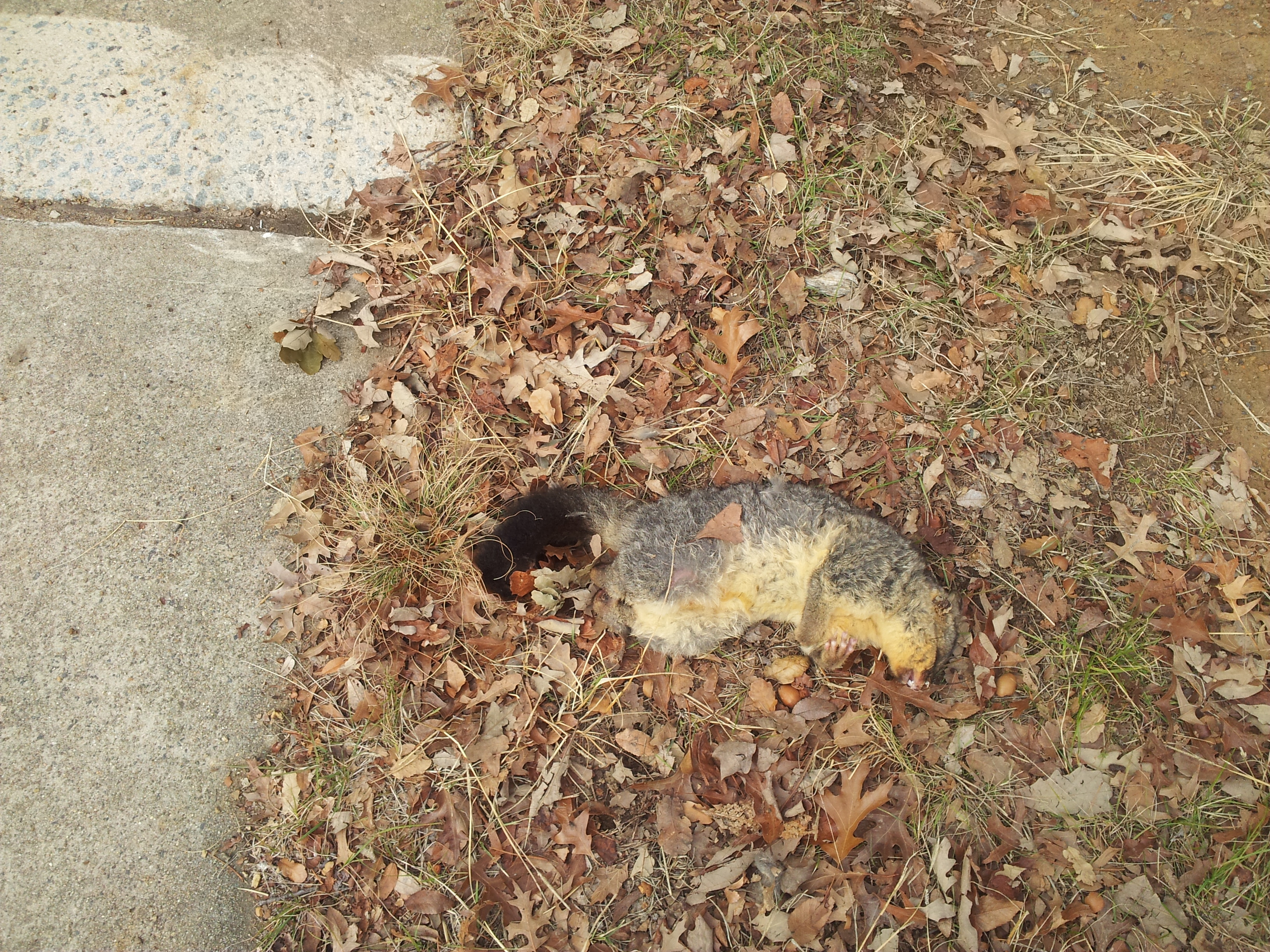
dead possum
Poor little guy found under power poles on the way back from my usual café. I think he* was electrocuted, rather than hit by a car, as there is no sign of injury. Some people in Australia hate possums, but I admire them for their ability to live amongst us, running over roofs and reminding us that we aren’t totally divorced from nature.
Off to do a reading soon of nearly all new material. God but I’m prolific! Prolific as a healthy possum with access to unlimited fruit. Which is, I hope, what a possum sees after death.
Other Tuesday poets are more punctual. Read them here.
*I can’t see a pouch, so I assume he.
 PS Cottier