New chapbook: Quick bright things
October 3, 2016
Here’s the cover of my new book, Quick bright things: Poems of fantasy and myth. It features an excellent illustration by Paul Summerfield, based on the poem ‘The Laws of Cricket rewritten for the Fairy World’ inside the book. It’s a chapbook, with 28 pages packed full of striking gnomes, somewhat sporty fairies, unpleasant elves, skiving but environmentally responsible goddesses, underachieving ghosts, paisley pitbulls, and similar oddnesses.
I particularly like the see through paper after the front cover (and before the back cover) but you can’t see that here. (A kind of parchment, I think.) It feels great, and adds an appropriate air of mystery to the chapbook. I am celebrating its arrival with a coffee in this photo.
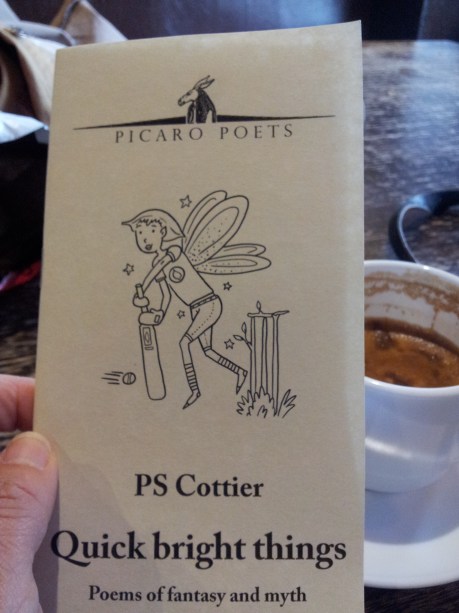
The title, by the way, comes from A Midsummer Night’s Dream, where Lysander says:
And ere a man hath power to say “Behold!”
The jaws of darkness do devour it up:
So quick bright things come to confusion.
The book is available from Ginninderra Press in the Picaro Press imprint. It costs $5 plus postage. Or buy it direct from me if you are in Canberra. I’m thinking about a wee launch for this wee book, although I’ll certainly be selling it at readings before any such potential extravaganza. (The ISBN is 9781760412197, by the way.)
Note that this is not a book intended for really little children, as some of the fantasy creatures are fairly awful. This is my first collection of purely speculative poetry, if we ignore The Stars Like Sand: Australian Speculative Poetry, which I edited with Tim Jones. And that is full of Other People’s Poems. Here is the cover in greater detail:

Overseas (or local) buyers can also contact me via the contact form. This is the best option if you’d like to arrange a signed copy.
Various poetic items: Including ruptures in the space-time continuum, and a poem.
September 25, 2016
Firstly, if you want to hear me talk about poetry at some length, and read a few poems, please go to the Verity La podcast. Michele Seminara and Alice Allan are the interviewers/fellow discussants, which means that they like hurling questions like flattened orbs, but in a polite kind of way. I am just getting up the courage to listen to myself.
Secondly, I was in a most excellent night at The Salt Room on Friday 23rd September. I was the first reader, armed with lectern, and stayed rooted to the spot, even if my poetry didn’t. I read about fantastic creatures and climate change.
Then came Miranda Lello, who read a long poem, or poetry sequence, called Election Day 2086 (a memoir, a map), which she had written for the reading. She also made a zine specifically for the night. The election described in very grounded in Canberra, but a Canberra that stands as a kind of ghost of the current one. Black Mountain Tower
‘…rises from the forest pointing
To our neo-retro-future selves
Empty for decades beaming signals to the stars –
Stories of school groups’ noisy chattering
The cruelty of children…
She is a great reader/performer, and I enjoyed her travels in time, and the way she recasts the very familiar in a slip of unfamiliarity. She needs no magic call box. Or lectern, either!
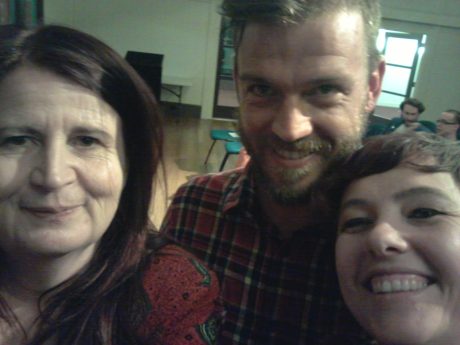
Scott Wings also dealt with time, but for me his use of space was the most remarkable thing; his crawling up a tree by lying on the floor, his pacing the room, so that even the shyer people up the back were made part of the performance. If you gave Scott a lectern, I think he’d probably use it in some unexpected way. His work is quite moving, too, dealing with aspects of his life and how he came to poetry. Here we all are:
Joel Barcham and Andrew Galan were their usual form of excellent, too, and I am very happy to have been asked to read at The Salt Room.
Yesterday (and thirdly) I went up to Sydney for the inagaural first Poetry at Sawmillers reading, and enjoyed the brief taste of the lower north shore. Some really good poetry read and performed, and I’ll post a link to the winner’s poem if it is published. For me, sitting at a local pub with a view of a bay and a bridge, sipping booze was so pleasant I can imagine another poet, say SP (“Sippy”) Cottier, who would miss the reading and simply stay on the terrace, sunning herself like one of the lizards living under the succulents on the deck who have no idea that they have a view worth about 3.5 million dollars.
But I am not that poet, and really enjoyed reading my poem, which I present forthwith:
7 ways to look at a sculpture
Firstly, it seemed a frozen poem,
which I read in different drafts
as I skirted around it.
Then it was time captured,
as if to trap the watchers,
and so release us from fervent rush.
By Wednesday I saw it more
as a mere mirror to catch
any cracked thought I threw at it —
but the next day it restated
its being as a question, set to
disrupt our certainties with what?
Friday, it seemed to push up the sky,
a small, persistent fist clenched
against wind and mess and change —
but this changed on Saturday.
The grass seemed to give birth to it
as tulip, rocket and shining tree,
which unfurled into beauty
on the stretching, languid, seventh day,
an exclamation, an endless ah!
P.S. Cottier
Now I am off to stare at the Verity La site to see if I’m brave enough to listen to me.
***I have also received my new chapbook, and will post about that very soon. That’s a fourthly.
UPDATE: I listened to the podcast and I’m not as inarticulate as I had feared. I particularly like the discussion on ecopoetry and climate change.
Tuesday Poem: A short wander through the head of a poet
August 15, 2016
A short wander through the head of a poet
‘I am finding a lot of this poeting business is learning how to hack your own thinking.’ (SB Wright)
Axing myself near every day
with nouns like blades
or is that the verbs,
sneaking and executing
behind my weary back?
Adverbs are the worst,
obviously, and I try
to expel them from thought.
Does a bear? Does a bear?
It doesn’t work, naturally.
My head is a jungle
of the old Tarzan sort,
and even a cunning machete
won’t clear a way,
despite avid hacking,
and the sticky tape I use
to reattach feckless fingers.
I will staple a handy volume
to my brow, perhaps
one that tells how
to write truth slant,
like Dickinson E,
and to be picaresque,
and appropriately Byronic.
A coupling that, of itself,
will cause sparks to leap
as if one were to jump start
an elderly ute gone bad.
Now, where are my cables?
Is this an Allen key
I see before me?
Statbadgers of the world unite!
Pick up your tongues like sticks,
and lick the befuddlement of brains
from cracked and gnarly windows.
P.S. Cottier

SB Wright is a poet who, this year, is detailing the process of writing and learning more about poetry at his blog. It is well worth a look. He is far more honest about the struggle involved in writing than many of us, particularly when it comes to how he manages a ‘real job’ (my words) while trying to write. He posts actual numbers, written by helpful Statbadgers for those who like that type of thing.
Occasionally he also posts one of the results of these struggles, aka a poem, and he frequently directs you to poems by others, or books and talks about poetics. (Poetics is like choreography, but involves people who are a lot more clumsy.)
SB Wright is not plagued by adverbs in his poetry, incidentally. That was poetic licence.
Tuesday poem: He wouldn’t know a poem…
August 9, 2016
He wouldn’t know a poem…
…if it had a business card that said A. Poem
(‘read me and weep’) which it presented to him
while waving a bright purple beret under his nose
(which organ is unable to detect the whiff of poesy)
while reciting itself, excitedly or coolly,
while pouring itself a sixth large glass of wine
(which would be hard, because of clutched beret and card case,
except that it would first return the beret to its poeting head,
at such an interesting angle, and would put the card case back
in a voluminous tote bag, full of its brother and sister poems
gathered into slim books which are now remaindered)
while squatting and shitting lines of the purest gold.
He just wouldn’t know it,
for what it seems to be.
P.S. Cottier
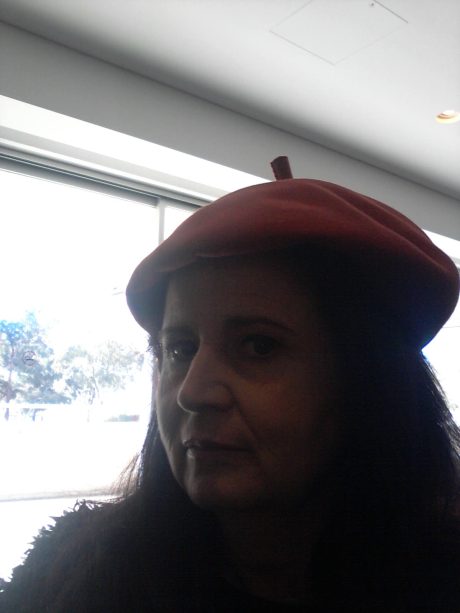
Talk to the beret
Now I could have the heading ‘nasty little poem’ for that but I’ve become a tad bored with that self-generated meme.
***
I’m been working on a little manuscript of fantasy poems at the moment; more about that anon. Speaking of that type of thing, there’s a nice competition on at the moment, run by the Science Fiction Poetry Association in the US, for poems of all lengths written in a speculative genre (fantasy, horror, science fiction etc.). If you write such things, why not have a go? It is only $2 (that’s the ‘somewhat more valuable than the Australian $ at the moment, but we’ll see after their election, American $’) to enter. You don’t have to be a member of the SFPA to enter (I am a member), and it would be lovely to have more Antipodean entries.
It closes at the end of the month, and entries can be lodged on-line.
Tuesday poem: Turn away
August 2, 2016
Turn away from the night.
Too much freedom is implied.
Trap stars in flags, pin them down,
render them national, bordered,
an angular abacus to figure normality.
Adorn children’s essays with thin
gold paper star stickers.
Wonder is juvenilia that we must
grow to despise, jettison
like milk teeth swapped for coin.
Yet those million suns, flickering
light sirens, keep calling, ululating.
Day demands in clear clipped diction
that we make work’s timed rituals
the sum of all equations. From such
abbreviation, each star whispers
turn away, turn to me,
turn to me, and turn away.
P.S. Cottier

I can’t remember if this has been published before; it’s not on my List, so probably not. There’s going to be a lot of flag waving soon at the Olympics (and, of course, in the final grim push to the US elections) so it seemed appropriate.

My poem ‘Criminals who are no longer criminals’ has been included in this year’s Award Winning Australian Writing, which included poems and prose that have previously been awarded first place in a literary competition (as you can probably read on the cover). The annual is published by Melbourne Books, and I’ll be going down for the launch late this month and reading the poem, which will be fun.
The poem qualified as it was placed first in the Thunderbolt Prize for Crime Writing, organised by the New England Writers Centre, and it is concerned with the definition of crime changing over time. It also has a speculative element, as there are ghosts involved.
I believe that the current Thunderbolt Prize is still open for entries: check out the rules and categories here.
 PS Cottier