Tuesday poem: Palm cockatoos
July 16, 2012
Palm cockatoos
Heads like a child’s drawing of bird heads,
huge beaks and feather manes, flopping,
last extant beat-poets, croaking of things
hep and cool. Man, you hit bedrock
on that arching drum, selecting the sticks
that give the deepest echo, sound playing
through tall wooden amplifier,
from dark roots to hazy blow of sky.
You contemplate the waving tops
of tropical trees, plumed angel-head,
stylish in your black daytime rhythm.
Inimitable pulsing punctuation,
beaky accent perched above
the forest’s bright green flow.
(The palm cockatoo is the only wild animal known to select, and possibly to store, sticks for use as musical instruments.)
P.S. Cottier
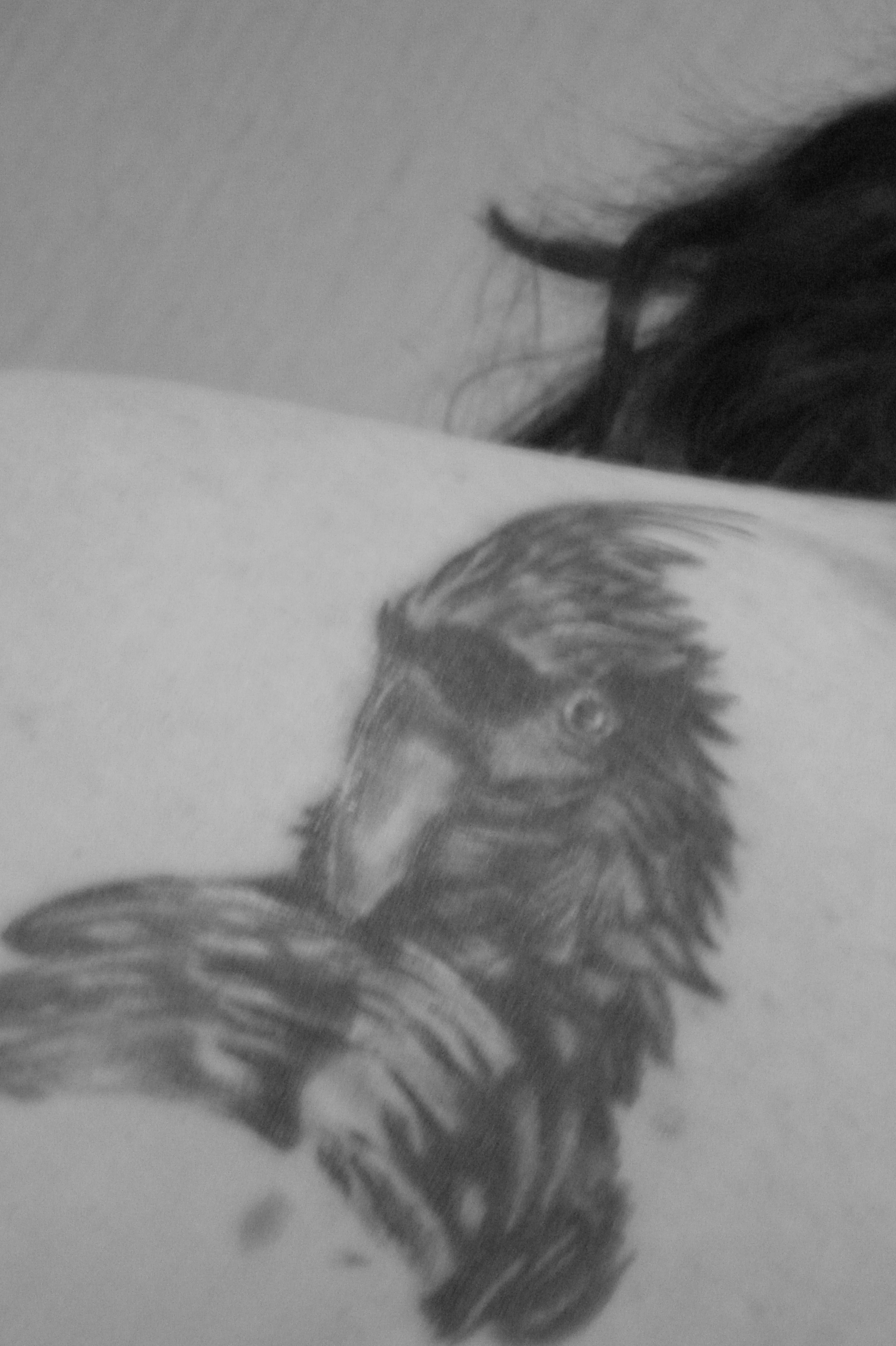
I am fascinated by palm cockatoos, although I have never even seen one. They live in the far tropical north of Queensland. The tattoo comes from much closer Queanbeyan, just over the border in New South Wales.
So why would you get a tattoo of a bird you have never seen? A little reminder that there are more things in heaven and earth…an encouragement to discover new worlds and boldly go…a cheap and less seedy way of being a pirate?
I don’t know, but I think the tattoo artist did a good job. (Thank you Carbine.) I have posted a black and white photo as the colour one I have makes my skin look a rather alarming yellow: just below nuclear buttercup. I will try and obtain a better photo, as the detail is blurred in this one. But this is my cockatattoo forever looking for sticks. My skin is the drum. Watch your finger!
For poetry, much of which is written in a country where tattoos are not unknown, please press this feather:

Malingering
July 2, 2012
That’s what I’ll be doing for the next two weeks. So no poem this week or next.
But I may feature a most poetic tattoo next time. Cheers.

Canberra has improved recently
For non-malingering poets, click this feather:

Ode on the Mammoth Cheese
Weighing over seven thousand pounds
We have seen the Queen of cheese,
Laying quietly at your ease,
Gently fanned by evening breeze —
Thy fair form no flies dare seize.
All gaily dressed soon you’ll go
To the great Provincial Show,
To be admired by many a beau
In the city of Toronto.
Cows numerous as a swarm of bees —
Or as the leaves upon the trees —
It did require to make thee please,
And stand unrivalled Queen of Cheese.
May you not receive a scar as
We have heard that Mr. Harris
Intends to send you off as far as
The great World’s show at Paris.
Of the youth — beware of these —
For some of them might rudely squeeze
And bite your cheek; then songs or glees
We could not sing o’ Queen of Cheese.
We’rt thou suspended from baloon,
You’d cast a shade, even at noon;
Folks would think it was the moon
About to fall and crush them soon.
James McIntyre

Two weeks ago, Helen McKinlay posted a subtle, surprising and interesting poem by Judy Brown called ‘The Cheese Room’. In her editorial notes, however, she mentioned James McIntyre, ‘Canada’s worst poet’, who wrote a lot about cheese. Now, as someone who recently published a poem by the Great McGonagall himself, the invitation to explore was impossible to resist. And this led me to this Homage to Fromage.
Now, the poem scans, unlike most of McGonagall, but the rhymes are dreadful. I particularly like ‘Beau’ and ‘Toronto’ which makes for a pronunciation of the Canadian city that one will surely never hear in real life. Most satisfying. Far less annoying to me than the GPS on my phone, which has an American accent and pronounces Canberra with the emphasis on the last syllable. (By the way, a University of ToronTOE site gives the spelling baloon, so who am I to argue?)
I must point out that McIntyre was born in Scotland, seemingly in 1827 (possibly 1828), making him a near contemporary of McGonagall (the latter’s dates are also somewhat murky, but 1825 seems to be generally accepted as the true birth year). ‘Oh Scotland, Scotland!’ as Macduff says. There must have been something in the air in the mid to late 1820s, when these two were conceived. If one reads the Ode, one can still catch a whiff.
I promise to be serious next time. Press this feather to see if any other Tuesday Poets have been scraping the bottom of the barrel, or if I’m the only one to go that whey.
Tuesday prose: Bloogled
June 18, 2012
Bloogled
Perhaps I shouldn’t have Googled myself. But who can honestly say they haven’t looked into that electronic mirror? If Jesus were around today, he’d probably be the only person on Earth not to even want to explore his computer self, those little masturbatory keystrokes revealing one’s achievements. Or lack of them. Me, I mean, not Jesus.
Don’t get me wrong. I only Google myself occasionally. I’d just had a poem published in Andromeda Street. I knew that of course, I’d checked out the site, but I needed to see the evidence reflected back to me, the great mathematical Google God presenting me to me on an airy platter. It’s deeply satisfying to see yourself emerge, like a woman in a bikini from an over-size sponge cake. Then the eye always travels to the crumbs, the other ‘me’s, the doppelgängers of name.
There aren’t too many Sebastian T. Smails in the world. It’s an unusual name. But there was a crumb this time, another me. Seems he was a writer too, but of short stories, not poetry. In Wyoming, U.S.A.. There was exactly one story by him, published in an American literary journal of the sort I dub Smart and Serious. Where genre is a very dirty word, and the readership sometimes reaches seven. But I’m a poet, so seven seems a fairly decent number. There was yet another Sebastian T. Smails with a trucking business in Queensland, called DeepNorthQwik. Only three in the whole electronic world, a tripod of Me, limping along. Better than being a John Smith, though, a centipede’s leg, lost in a moving forest of abundance.
I did some work, finishing a sonnet about trees and age, in which the word ‘autumnal’ did not make a single appearance. It was taut. It was elegant. It was good enough to send off to Wombat, the right wing journal which has Australia’s most brilliant poet as the literary editor. So far I’d only scored form rejections, not even personal ones from the great man.
But this time he liked it, and eventually my fourteen lines appeared wedged between an article about how the existence of the Stolen Generations was a myth, and another about how being stolen was good for Aborigines anyway, because they learnt so many useful things. Like logic, presumably. I only had eyes for my poem, though. In real black print, not that electronic pixelated muck. And then, a fortnight later, I Googled myself…
…and found that Sebastian T. Smails of Wyoming, now had a personal web-site, and my poem ‘Transpiration’ was listed under ‘Recent Publications.’ I sat, staring at the fat-faced American. He was wearing a dark beret, and had his head on an angle, as if he were just too intelligent to view things straight on, too totally quirky and poetic. He looked like a French cockatoo who’d been hitting the crackers and absinthe a bit too hard.
I e-mailed him saying that unless he removed the reference to my poem immediately, I would sue. This was a sad joke. Copyright lawyers aren’t cheap, and my total earnings from poetry totalled $672, including the $50 cheque I expected from Wombat. The wages from my day job, as a library assistant, were squandered on rent and food and other luxuries.
I waited a month for that cheque, fuming at the American Sebastian, sending him more and more irate e-mails. Eventually I rang Wombat, and the office administrator reminded me that I’d requested an electronic payment so I wouldn’t have to pay for depositing a cheque made out in a foreign currency. I was too stunned to argue. How had the other Smails known to ask for the electronic payment before the poem had appeared? Or had he rung afterwards, just in case payment had not been made? Who’d go to that much trouble for $50, anyway? Our plucky Aussie dollar may be worth almost as much as a real God-trusting dollar these days, but still, it seemed a little desperate.
I forced myself to do a little work on the manuscript I was about to submit to a publisher. No identity-stealing American was going to stop me seeing it in print, turning the pages, feeling its slender beauty. I fell asleep, dreaming of Lord Byron, who awoke one morning to find himself famous…
…and awoke to discover that the American Smails had a poetry collection called Leaving about to be published by Castanets, in London. Need I tell you the name of my intended book? I think not, attentive reader. I think not. The manuscript sat on my desk, next to the cubist Cyclops eye of the computer, ready to go. I would never have sent it to Castanets though. That was a bold move on behalf of the Septic Smails. I was thinking much smaller. Local, in fact. I opened my e-mails.
There were twelve urgent messages, from me, sent to someone of my name, each more desperate than the preceding one. I found a copy of a contract sent by Castanets, signed with a familiar signature. My electronic transfer account had new funds, too. I reached for a mirror. I’d obviously been working too hard. I’d put on weight, and my hair was thinning. I groped for my coffee, and my hand caressed a piece of cloth. A beret. It was black. It fitted perfectly.
Obviously, I was being consumed by that other me, like a 1950s film where a big red cloud of Communist rubber sucks people in and eats them. Only, I had to ask, was it really so bad? American me was doing better than I was. Better than I could reasonably have hoped to do. I could attend readings, continue writing, and it seemed some money was finally trickling in. If my identity was being subsumed, I didn’t really care. Eat away, Google blob, I thought. Suck me up. I’m yours.
Then I heard the trucks, a dozen of them, rumbling outside my window. A man in a blue singlet was knocking at my door, yelling ‘Boss’, holding a clip-board. I felt the beret morph into a cap, my beer-gut spill over my suddenly short shorts. I’d been Bloogled again. I grabbed my manifest, and headed for the door.
P.S. Cottier

‘Bloogled’ won third prize in the 2009 ‘Best of Times’ humorous short story competition and was published on the competition web-site, November 2009. Judged by Chris Broadribb, who also organises these competitions.
I was going to write something new in honour of National Flash Fiction Day (the 22nd June) in New Zealand, but my mind is simply not working in prose at the moment, so I recycled this one. (The attentive reader will note that the hero-loser of my story is a poet. At least most of the time.) At just over 1000 words, it’s arguably too long to be flash. It falls into the dead realm between flash and what is regarded as a ‘proper’ short story. Many narratives go wandering in that desert, and few are ever seen again.
Unusually for anything I write, there is the tiniest inkling of plot detectable here. Most ultra-shorts I enter in flash competitions are in fact prose poems. Please don’t tell anyone, though.
I look forward to seeing if any eligible Tuesday poets win prizes in the national flash fiction competition being finalised now in New Zealand. There’s at least one title on the shortlist that could possibly belong to a Tuesday poet, methinks. But I won’t provide clues as to who I think that may be. Because I’m probably wrong.
For proper flash fiction, press this feather:
The central post is by Tuesday Poet Michelle Elvy, who has been organising the National Flash Fiction Day in New Zealand.
Cricket Poetry Award: Line and length
June 15, 2012
Perhaps that should be lines. The Cricket Poetry Award closes on 31st August, so if you have an idea for a poem about playing or watching cricket, it’s time to pad up.
The prize is $2000 AUD, entry is $20, which can be done by Paypal, and the announcement of the winner is made at the SCG members pavilion. The top twenty poems from each year have previously been published in a booklet.
Entry forms and full conditions can be found here. There is a tight word limit of 150, so there is no defensive play allowed. No Boycott. Only Gower. And that has to be a good thing.

Bloody batting metaphors. Grumble grumble.

 PS Cottier