Tuesday poem: Love letters
November 22, 2016
Love letters
I love you poetry because all I need is an old envelope — Telstra or power bill or guff — and a pen
And you wait there hidden between the grains of paper like a wee tiger, pouncing, or a huge poodle, primping
I can write you for everyone, or just for me
And through you I have met clever people, and some even good (and also pricks, but let’s not dwell in embroidery)
Poetry you keep my mind in the top fifteen percent of my generation
And you make me embed my thought in Real Words™ like a bloodbug in a mattress, burrowing
I weep for you when some use your name to produce pungent advertisements for self — ah! the faces I have slapped, the duels I have fought in your name (if only on paper)
You allow me to take a word — say egregious — and handball it back to myself with slicker hands than Hawthorn
And you stretch back and forward as far as music
And you adapt like Galapagos, but quick
Tourniquet and snake, you bite and comfort, and I love you like a convenient maiden aunt loves her old cat, who miraculously survived the pitbull
And you are the very pitbull, and the pitbull’s teeth.
P.S.Cottier
***
And in vaguely related news, I was just highly commended in the Poetry category of the Thunderbolt Prize for Crime Writing, organised by the New England Writers Centre. Very nice. The winner of the poetry prize (which I won last year) was Ian Hood, with a poem called ‘Drowning Satan’, which I look forward to reading. Paul Prenter was commended. All the poems (and stories, etc) will be published soon at the New England Writers Centre website, and I’ll link to that when I can. My poem ‘On average’ was about domestic violence.
The judge was John Foulcher, a fellow Canberran. (Judging was, of course, anonymous.)

P.S. ‘Hawthorn’ in the above, is an Australian Rules football team, who have dominated things over the last five years or so. (Until this year, in fact.) Another helpful guide to Australian culture for benighted foreigners my lovely overseas readers.
P.P.S. Pitbulls are awesome dogs, and are only vicious if abused.
Tuesday poem: There are five poets in my garden
November 8, 2016
There are five poets in my garden
— and they think that they are bulbs.
But the first one smells carcinogenic,
and he is clothed in ancient brown,
as if he stole the mud-flecked jumper
from the very body of a bog-man.
The second is talking about
the fervid dangers of Pokémon,
and how in her day, they looked
for birds, and birds were quite enough.
She has a collection of empty eggs,
pilfered in her day, which lie
in an ancient purloined nest —
a weird eunuch’s severed balls,
placed in a stolen cup of misery.
Number three is being thoughtful.
He never utters a sentence without
a French theorist’s name —
like a pigeon (of stolen eggs) he says
Bourdieu, Bourdieu, and oui, he bores me.
Number four is addicted to rhyme.
He knows he is somewhat out of time,
but like a tune you know too well,
he is married to the villanelle.
And the fifth? She plants sarcasm
in a weedy succulent garden,
where such thin green tongues
poke like wee prickly dragons.
She’s fully awesome, and awfully sweet.
P.S. Cottier

I’ve been thinking too much this week about how any field of endeavour contains exactly the same percentage of unpleasant people as all the others. Whether it be poetry or painting, rugby or beekeeping, there will be the same proportion of selfish people and the likeable. Perhaps politics is a genuine exception, and contains more of the unlikeable, but generally speaking, anywhere there are people there will be all the character types, regardless of whether it is a profession where a certain amount of empathy might be expected.
Indeed, the type of poet who bangs on about his sensitivity to nature (in the sense of a convenient green strip outside his window, sans history) often seems to lean towards the arsehole side of the equation. If equations really have sides. Or arseholes.
Discuss.
Tuesday poem: No streets, or maps to find them
October 18, 2016
It’s by link to Tim Jones’s site, where he posts a poem from my new chapbook Quick Bright Things: Poems of Fantasy and Myth. He also gives some commentary on the poem and the book, which is cool as a sea cucumber. (The poem is about a sunken city, hence the sea imagery creeping in there. Or sliding, or however sea cukes move.)
I was thinking of posting an appropriate Atlantis type image, but here instead is the cover of the book once again, with the cricketing fairy drawn by Paul Summerfield. You can buy a copy here.

Tuesday poem: ‘…Transient creatures that swarm and multiply…’
October 10, 2016
‘…Transient creatures that swarm and multiply…’
Galaxies expanding —
every grass patch blinks
with five hundred petalled suns.
Bees travel between them
mining pollen from stars.
Aliens hover amongst us,
just like us in gold lust
and frantic accumulation.
For us, though,
it’s always spring,
exempt from rumours
of compromising change.
Our ears are buzzing
with far less than bees.
The canals are Martian,
quite epically empty.
P.S. Cottier

The quotation in the title is from The War of the Worlds by H.G. Wells. The quote refers to microscopic creatures, but we shall not quibble. The canals on Mars, exploited in the poem for a pun, turned out to be mere features of topography (Here I must insert a green alien saying ‘That’s what you think!’ followed by a sinister laugh. It’s compulsory.)
Mining anything from stars would be a tad difficult, I know, but I’ll flourish my poetic licence on that one, to any cruising and literal minded traffic cops of the blogosphere.
There’s a great tradition of books about creating a breathable atmosphere on Mars, and I’m also harnessing that to a poem partly about our rabid experimentation with earth’s climate.
It’s amazing where a patch of daisies can lead you!
UPDATE: So the gutless NSW Premier has changed his mind on banning greyhound racing. Cruelty 1, Compassion 0. I’ll be interested to see what the ACT government does in response.
Various poetic items: Including ruptures in the space-time continuum, and a poem.
September 25, 2016
Firstly, if you want to hear me talk about poetry at some length, and read a few poems, please go to the Verity La podcast. Michele Seminara and Alice Allan are the interviewers/fellow discussants, which means that they like hurling questions like flattened orbs, but in a polite kind of way. I am just getting up the courage to listen to myself.
Secondly, I was in a most excellent night at The Salt Room on Friday 23rd September. I was the first reader, armed with lectern, and stayed rooted to the spot, even if my poetry didn’t. I read about fantastic creatures and climate change.
Then came Miranda Lello, who read a long poem, or poetry sequence, called Election Day 2086 (a memoir, a map), which she had written for the reading. She also made a zine specifically for the night. The election described in very grounded in Canberra, but a Canberra that stands as a kind of ghost of the current one. Black Mountain Tower
‘…rises from the forest pointing
To our neo-retro-future selves
Empty for decades beaming signals to the stars –
Stories of school groups’ noisy chattering
The cruelty of children…
She is a great reader/performer, and I enjoyed her travels in time, and the way she recasts the very familiar in a slip of unfamiliarity. She needs no magic call box. Or lectern, either!
Scott Wings also dealt with time, but for me his use of space was the most remarkable thing; his crawling up a tree by lying on the floor, his pacing the room, so that even the shyer people up the back were made part of the performance. If you gave Scott a lectern, I think he’d probably use it in some unexpected way. His work is quite moving, too, dealing with aspects of his life and how he came to poetry. Here we all are:
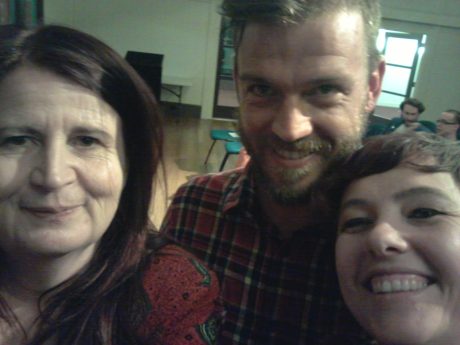
Joel Barcham and Andrew Galan were their usual form of excellent, too, and I am very happy to have been asked to read at The Salt Room.
Yesterday (and thirdly) I went up to Sydney for the inagaural first Poetry at Sawmillers reading, and enjoyed the brief taste of the lower north shore. Some really good poetry read and performed, and I’ll post a link to the winner’s poem if it is published. For me, sitting at a local pub with a view of a bay and a bridge, sipping booze was so pleasant I can imagine another poet, say SP (“Sippy”) Cottier, who would miss the reading and simply stay on the terrace, sunning herself like one of the lizards living under the succulents on the deck who have no idea that they have a view worth about 3.5 million dollars.
But I am not that poet, and really enjoyed reading my poem, which I present forthwith:
7 ways to look at a sculpture
Firstly, it seemed a frozen poem,
which I read in different drafts
as I skirted around it.
Then it was time captured,
as if to trap the watchers,
and so release us from fervent rush.
By Wednesday I saw it more
as a mere mirror to catch
any cracked thought I threw at it —
but the next day it restated
its being as a question, set to
disrupt our certainties with what?
Friday, it seemed to push up the sky,
a small, persistent fist clenched
against wind and mess and change —
but this changed on Saturday.
The grass seemed to give birth to it
as tulip, rocket and shining tree,
which unfurled into beauty
on the stretching, languid, seventh day,
an exclamation, an endless ah!
P.S. Cottier
Now I am off to stare at the Verity La site to see if I’m brave enough to listen to me.
***I have also received my new chapbook, and will post about that very soon. That’s a fourthly.
UPDATE: I listened to the podcast and I’m not as inarticulate as I had feared. I particularly like the discussion on ecopoetry and climate change.
 PS Cottier