Look what I found at the beach…
February 6, 2014
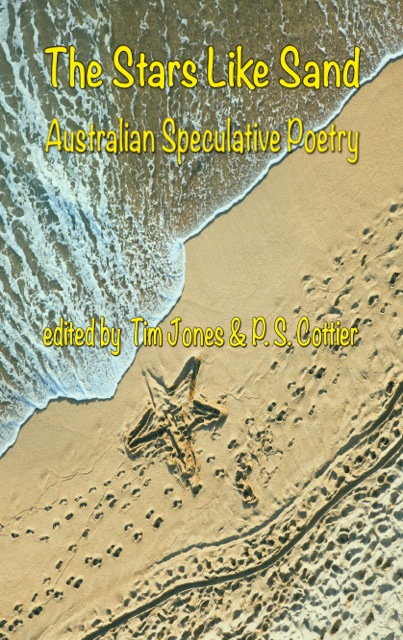
This is a small version of the cover for The Stars Like Sand: Australian Speculative Poetry (Interactive Publications), which should be out in late April. Click for a better look.
Not a bad piece of flotsam. Or is that jetsam? No, they were the cartoon characters who lived in a perfect American future, weren’t they? With nifty jetpacks?
When all this egregious specpo is over, I am going to read a novel of such staunch realism that you wouldn’t read about it. With a plot so heavy it would drown you, if you read it on a lilo floating on a pool.
Unless, of course, it was a hover-lilo. Now there’s the ultimate personal transport device. I sneer at your pathetic jet-packs, American cartoon people.
Endgame: The anthology
November 12, 2013
We are finalising The Stars Like Sand: Australian Speculative Poetry. Here is a recent photograph of me as I enjoy the process of fine-tuning things:
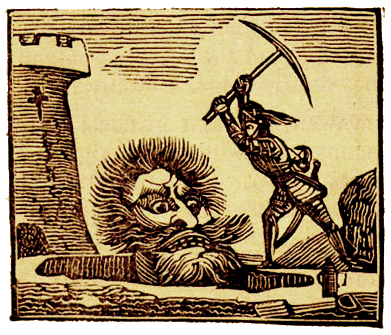
I am both the one in the hole and the one with the weapon.
My only consolation is that Tim Jones, co-editor, probably looks worse…
It will be a wonderful day when I hold the book in my hands, and all this egregious checking is out of the way. Then I’ll no doubt find a typo, and hit myself over the head with that.
Well, that was nice
July 18, 2013
Wellington could be covered by a giant’s pocket handkerchief. Such a lovely place, even when there are four consecutive days with gusts of rain that are correctly described, in meteorological terms, as gusty.
I enjoyed my short stay there, working on lists of poems with Tim Jones, who is a very patient and funny person. Tim lives in the right place, as he very easily overheats. ‘I’ll just take my coat off,’ he says, quite frequently. Also ‘Is that heater too high?’. To which the correct answer is ‘NO!’ I don’t think he would like Darwin…or tropical Canberra.
I met many Tuesday poets in Wellington, including Mary McCallum, Keith Westwater, Helen Rickerby (publisher of Maria McMillan’s wonderful collection The Rope Walk, which is such an attractive book, and the launch for which I was lucky enough to attend) Harvey Malloy, and Janis Freegard. So nice to meet people only known electronically!
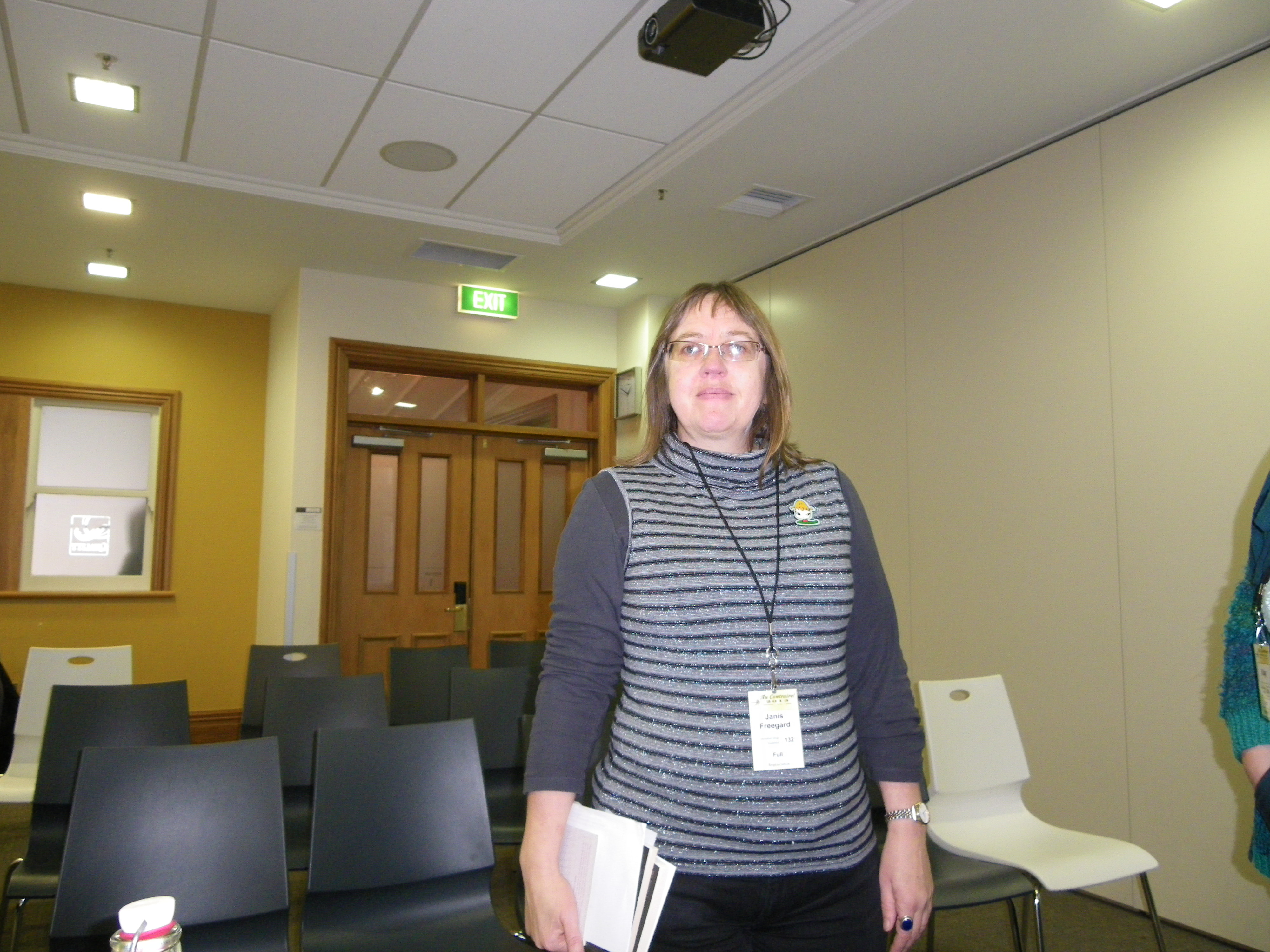
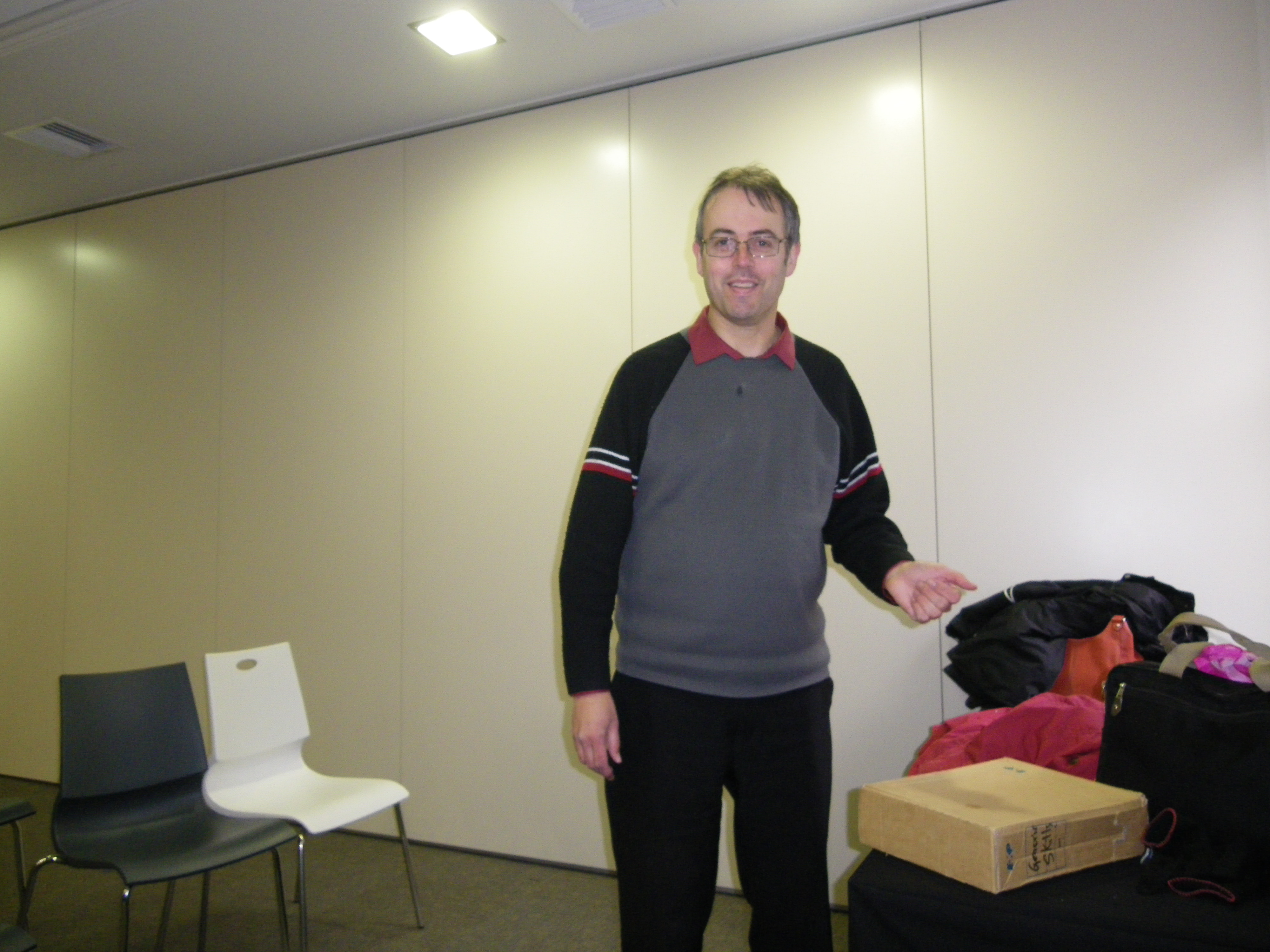
Tim, Harvey, Janis and I gave a reading at Au Contraire. I think that the full range of speculative poetry was represented, including Janis’s surrealist works and Harvey’s delicate ghost poems. Some of Tim’s were science fiction, and some of mine were horror. Here are photos of the other three poets:

So busily engaged in going through massive numbers of poems with Tim meant that I was unable to engage with the Convention very much, but I also enjoyed the poetry workshop I went to, run by Harvey and Tim. I may post the poem I wrote in ten minutes for my Tuesday Poem next week. I also attended the Julius Vogel Awards, where Simon Petrie, who I had talked at at the airport in Sydney for hours, picked up a gong. Simon also has a story in the new collection Regeneration, as does Tim. I must admit I have read a couple of stories, thus compromising my vow to read no prose for a year, but after working through literally thousands of poems, I excused myself. Sometimes, when tired, prose is easier to read than poetry, being inferior and all. (The stories, however, are of a particularly high standard.)
I meant to take a group photo of Tuesday Poets drinking, but I forgot. Here is a nice photo of Mary, though.
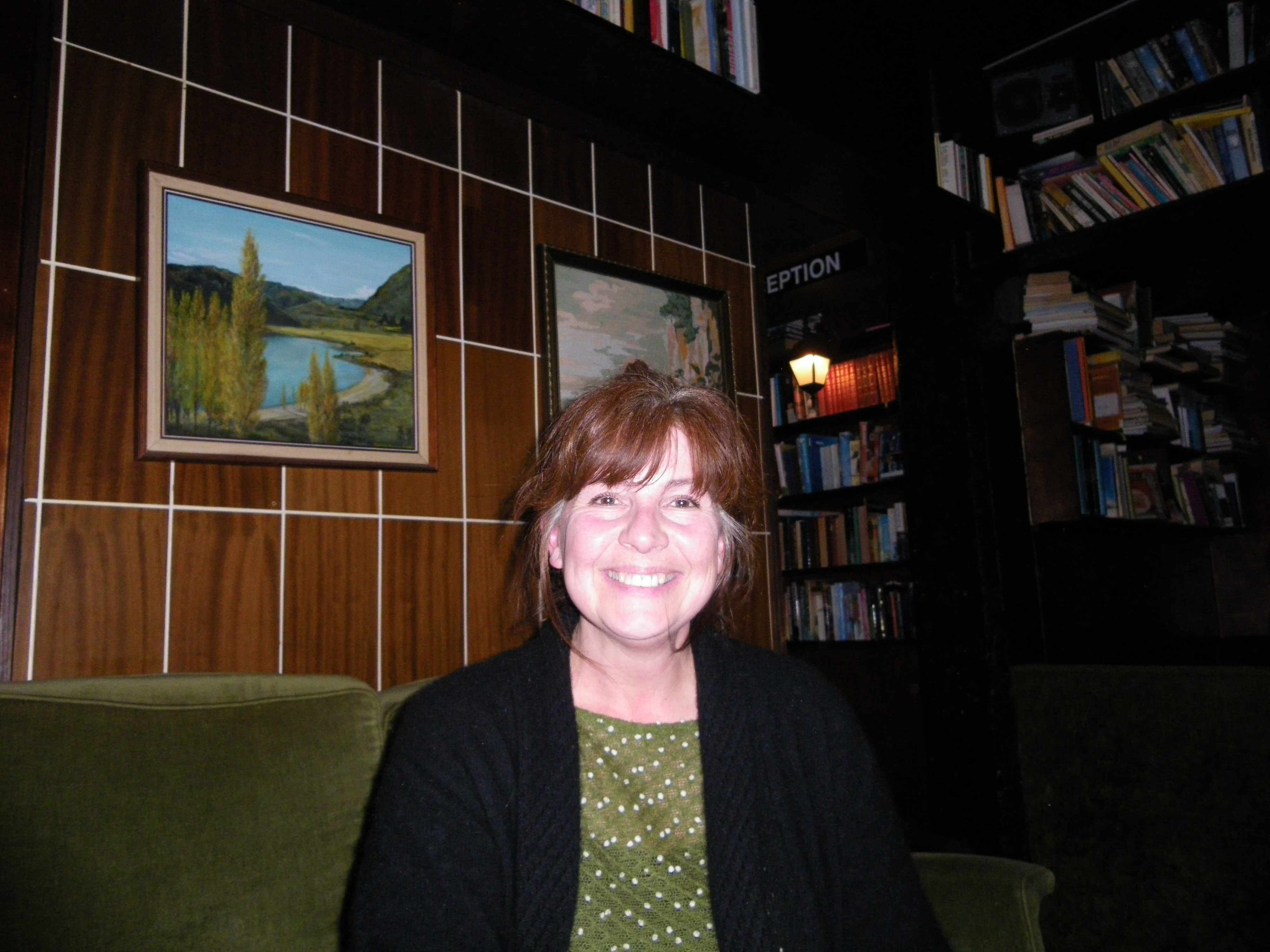
I realised after uploading this just now that she is wearing a top that I had been eyeing off on Cuba Street for a few days and bought on my last day after another few hours tireless (I typed ‘fireless’ at first, which would certainly have pleased Tim) anthologising. It was so dark in the Library Bar where me met that I didn’t consciously note it was the garment I had been admiring. Mary is a trendsetter, so much so that it works at a subconscious level! I wish I could have talked to her more, and all the other poets.
I have no profound thoughts to offer about New Zealand or Wellington after my few days there (I am always suspicious of instant summaries of other countries by blow-ins) but it is a place in which I felt very comfortable. I think it is legitimate to make comparisons with Canberra, too, given that both Wellington and Canberra are smaller capital cities with larger cities within the same country.
The public service seems to dominate Wellington far less than it does Canberra. You just don’t see so many people wandering around with their security tags on lanyards around their necks, like besuited dogs from a Russian novel. Perhaps security is slacker? (Or stricter, given this open display of ID has always seemed a strange practice.) Perhaps I was in an area of Wellington entirely inhabited by web designers, small press publishers and the owners of interesting boutiques? But I also noticed that conversations that I overheard were not so much about the minutiae of policy or whinges about conditions in the public service. Or upcoming elections as they are in Canberra at the moment!
This may seem a slightly bizarre comment, but there are far fewer blonde or redheaded people in Wellington than in Canberra. (I am talking about people of European origin here, obviously.) I have no idea why this is the case, but it struck me that only one person in a cafe was a redhead. Perhaps it is illegal for redheads to frequent Cuba Street?
It would be so good to live somewhere where walking was the major means of getting around. On the other hand, Canberra is much better for bicycles, at least in the inner city.
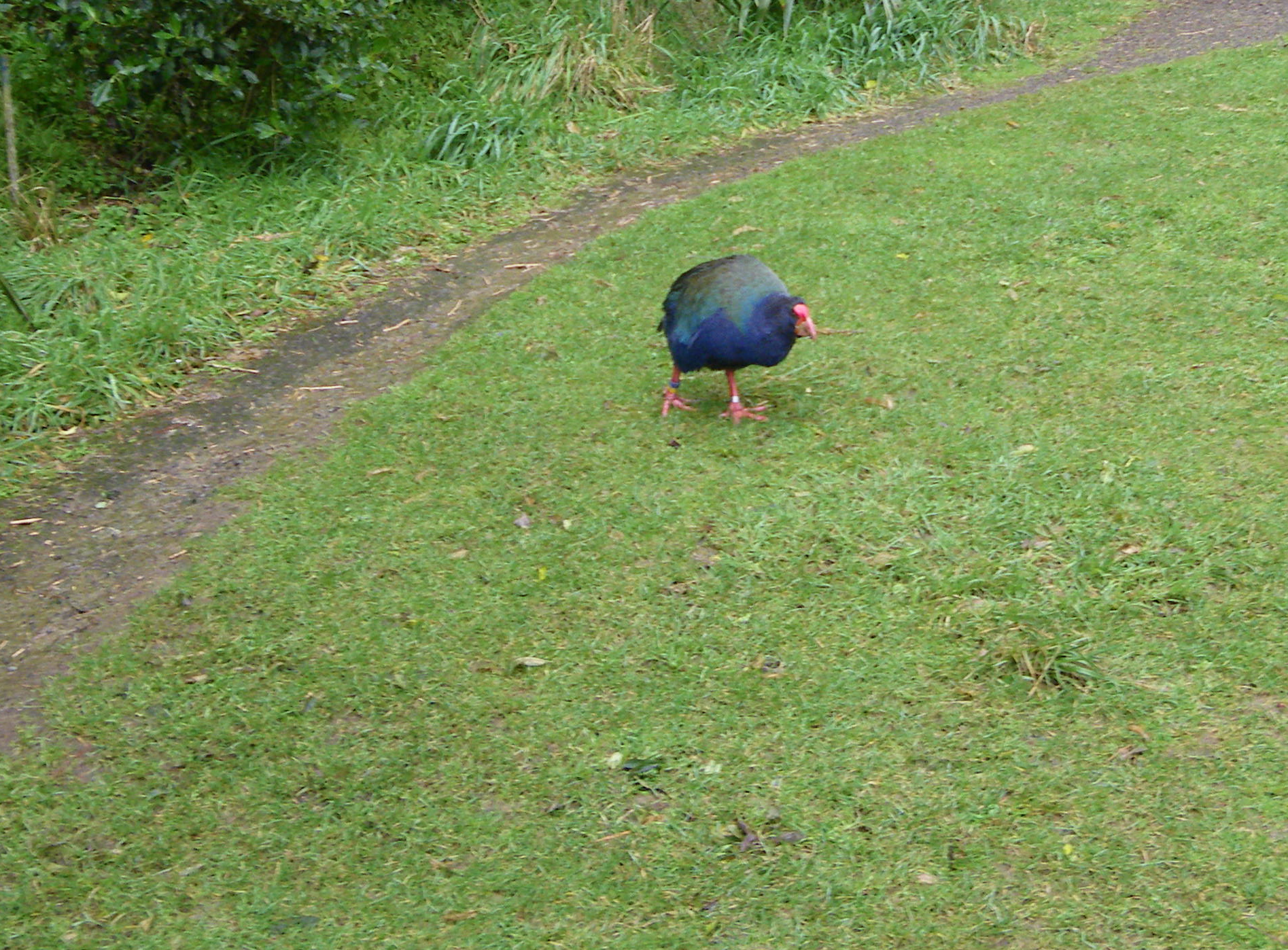
I ate and drank far far too much during my stay, burning off the equivalent of about one glass of wine during a leisurely stroll around part of the Zealandia wildlife sanctuary. The takahe, a fat, flightless bird, spend their lives munching grass. The story of their rediscovery is quite moving. Such placid, helpless creatures.
Less reassuring were the warning signs about what to do in case of an earthquake; with profound ignorance I hadn’t realised that Wellington was particularly prone to earthquakes. Certainly that is not talked about in the guides to cool Wellington on the net!
I do hope to have a longer stay in New Zealand next time. Here I am looking a tad rugged up at the wildlife park.

Thank you to everyone for being so welcoming, and especially to Tim. I met so many people that it’s quite likely I forgot to include a name or two, so this may need a few edits…
VITAL UPDATE: According to the site Answers, 4% of Australians have red hair and about 2.5% of New Zealanders.
World tour of one part of New Zealand…
July 3, 2013
…one part of the North Island of New Zealand, in fact.
Yes, next week I’ll be popping over to our comparatively near neighbours and meeting other Tuesday Poets, and particularly Tim Jones, with whom I am editing The Stars Like Sand: Australian Speculative Poetry.
We will be making final selections for the anthology, from the approximately nine million on our two lists of ‘must haves’. I’m also one of four poets reading at Au Contraire, a science fiction convention in Wellington.
And I hope to sneak off from poetry duties long enough to see a dead Colossal Squid on display, and also to see some live, medium-sized birds.
I really can’t wait. (That is not sarcastic, for once, by the way.)
I have visited New Zealand once before when I was a teenager on a school trip, and have vague memories of an extremely racist bus driver, a wool museum (like Australians really don’t have enough wool and need to visit other people’s wool museums), and the smell of Rotorua.
I look forward to contrasting Canberra with Wellington. The populations of the two cities are about the same. That fact says a little more about Canberra, I think, than Wellington.
So busy have I been preparing Vast Lists of speculative poetry that I have no poem to post this week, and next week may be dodgy too, as I’ll be buying things for Wellington.
Wool things, mostly.
Poetry wanted for new anthology: guidelines
February 25, 2013
The Stars Like Sand: Australian Speculative Poetry – Call for Submissions
Here are the detailed submission guidelines for the anthology I am editing with Tim Jones. Can’t wait to be reading the submissions after they close on June fourth. That gives you about three months, so pick up your quill or iPad and start writing, and/or rummage through your vast collection of previously published speculative poetry, and send some in to us, dear Australian poets!

THE ANTHOLOGY
The Stars Like Sand is a planned anthology of Australian speculative poetry. Speculative poetry is poetry in the science fiction, fantasy, horror and related genres. (Please see below for a fuller definition.) It is intended that the anthology will include both new and previously-published poetry, and include a historical survey of the field. The anthology is intended for publication in 2014.
The anthology will be published by IP (Interactive Publications Pty Ltd) of Brisbane, a leading Australian poetry publisher. IP previously published Voyagers: Science Fiction Poetry from New Zealand in 2009 Further information about IP is below.
The editors are New Zealand poet Tim Jones, who co-edited Voyagers, and Australian poet P. S. Cottier. Please see the editor bios below.
SUBMISSION GUIDELINES
Please note: Submissions do that not follow the guidelines below are unlikely be successful. In particular, attachments will not be read.
1) Submissions are now open. Please submit your poem(s) by midnight on date 04/06/2013. Any submissions received after the editors check their email the following morning will not be considered.
Submission format
2) Send no more than three (3) poems in an email message to starslikesand@gmail.com with the subject line “Submission to The Stars Like Sand”.
If you submit more than three poems, whether in one message or in separate messages, we will read only the first three you submit. You are welcome to send fewer than three poems.
3) Include your poem(s) in the body of your email message. Do not send attachments. Attachments will be not be read.
If your poem has special formatting requirements which cannot be reproduced in the body of an email, please send it anyway within the body of your email, but include a note about the formatting requirements. If necessary, we will get back to you to request a copy in the correct format.
4) Due to space limitations, we prefer to be sent poems of 50 lines or less. While we will still read longer submissions, they will have to be exceptional to be included. There is no lower limit on lines, so you are welcome to send haiku and other short forms, provided you send no more than three poems in total.
5) You are welcome to submit both unpublished and previously-published poems:
a) Unpublished poems: Unpublished poems selected for inclusion will be eligible for the Rhysling Awards: see http://www.sfpoetry.com/rhysling.html
b) Previously-published poems: Please supply full details of previous publication, including online, magazine and book publication. If permission is required from a publisher for your poem to be reprinted, we will ask you for the publisher’s contact details, and for your help with securing permission to reprint the poem in “The Stars Like Sand” should your poem be selected for inclusion.
6) If you are unsure what speculative poetry is, please see the notes below. If you are still not sure whether your poem fits, please send it anyway – we would rather read some poems that don’t fit than miss out on good but “borderline” poems.
7) After your poem(s), please include a biography of no more than 100 words in the body of your email message. Your biography may be edited for reasons of space.
Responding to submissions
8) We will respond to all submissions as quickly as possible. However, the time taken to respond depends on the volume of submissions received. Please be aware that, due to size limitations on the anthology, many submitted poems of merit will, unfortunately, have to be rejected.
9) Previous experience suggests that we are unlikely to be able to include all the previously-published poems we initially select for inclusion, due to difficulties obtaining reprint permissions. Should this occur, we may return to some poems that we were unable to include in our initial selection and ask the poets whether we can now include these poems in the anthology. We will do this only as and when necessary, so please do not resubmit poems which were initially rejected, or submit new poems, unless we ask you to.
Payment
10) All poets included, or their estates in the case of deceased poets, will receive a free copy of the anthology. There will no monetary payment for included poems.
Who can submit?
11) Residents of Australia, and Australians not currently resident in Australia, are eligible to submit. If you are unsure whether you are eligible to submit, please include a note in your email submission letting us know your situation.
WHAT IS SPECULATIVE POETRY?
Speculative poetry is poetry that falls within the genres of science fiction, fantasy, and horror, plus some related genres such as magic realism, metafiction, and fabulation. It is not easy to give precise definitions, partly because many of these genres are framed in term of fiction rather than poetry.
A good starting point is “”About Science Fiction Poetry” by Suzette Haden Elgin, the founder of the Science Fiction Poetry Association, which you can read here: http://www.sfwa.org/members/elgin/SFPoetry.html
Despite its title, this article is applicable to all forms of speculative poetry.
ABOUT THE EDITORS
Tim Jones
Tim Jones is a New Zealand poet and author of both literary fiction and science fiction who was awarded the New Zealand Society of Authors Janet Frame Memorial Award for Literature in 2010.
Among his recent books are a fantasy novel Anarya’s Secret (RedBrick, 2007), short story collection Transported (Vintage, 2008), and poetry anthology Voyagers: Science Fiction Poetry from New Zealand (Interactive Press, 2009), co-edited with Mark Pirie. Voyagers won the “Best Collected Work” category in the 2010 Sir Julius Vogel Awards. Tim’s third poetry collection, Men Briefly Explained, was published by IP in late 2011.
Tim’s poem “The Translator” appeared in Best New Zealand Poems 2004, and his short fiction has appeared in, among many other venues, Best New Zealand Fiction 4 (2007), and The Penguin Book of Contemporary New Zealand Short Stories (2009). His short story “The New Neighbours” was included in The Apex Book of World SF, Volume 2 (2012).
In 2011, Tim edited a special issue of the Science Fiction Poetry Association’s online journal Eye to the Telescope, devoted to speculative poetry by Australian and New Zealand poets.
P. S. Cottier
P.S. Cottier’s third poetry collection is the suite of poems “Selection Criteria for Death”, published in Triptych Poets Issue Three, Blemish Books in 2012. She has shared the David Campbell Award, given for the best unpublished poem by an ACT region writer. Her prose poem “Pod, cast”, originally awarded first place in a US science fiction competition in 2008, was included in The Indigo Book of Australian Prose Poems (2011). Penelope has had many fantasy and science fiction poems published in non-genre journals and newspapers, such as The Canberra Times and Eureka Street.
Penelope is also widely published in speculative journals in Australia and elsewhere, such as Star*Line (US) and Chiaroscuro: Treatments of Light and Shade in words (Canada). Her poem “Fingernails” was recently nominated for the Rhysling Awards, and her magic realist poem “Eight things you may not know about Vladimir Putin’s dog” was included in the inaugural Australian Poetry members’ anthology.
She wrote her PhD in literature at the Australian National University.
ABOUT IP
Interactive Publications Pty Ltd has been in business since 1994 and has been growing steadily since then. IP currently publishes 35+ titles per year, and is the second largest publisher of literary titles in Queensland.
Interactive Press is one of four imprints of IP. Interactive Press is one of the leading poetry imprints in Australia, publishing up to eight titles each year. Interactive Press titles are generally released via conventional print, as well as in print on demand (POD) and various eBook formats for outlets such as Amazon, Apple, Google, Kobo, Overdrive, eBooks Corp and Wheelers, making them accessible to audiences world-wide.
IP’s publisher is Dr David Reiter, himself a prize-winning poet and author.
 PS Cottier