Tuesday poem: Mental cases by Wilfred Owen
April 23, 2012
Mental cases
Who are these? Why sit they here in twilight?
Wherefore rock they, purgatorial shadows,
Drooping tongues from jaws that slob their relish,
Baring teeth that leer like skulls’ tongues wicked?
Stroke on stroke of pain, – but what slow panic,
Gouged these chasms round their fretted sockets?
Ever from their hair and through their hand palms
Misery swelters. Surely we have perished
Sleeping, and walk hell; but who these hellish?
– These are men whose minds the Dead have ravished.
Memory fingers in their hair of murders,
Multitudinous murders they once witnessed.
Wading sloughs of flesh these helpless wander,
Treading blood from lungs that had loved laughter.
Always they must see these things and hear them,
Batter of guns and shatter of flying muscles,
Carnage incomparable and human squander
Rucked too thick for these men’s extrication.
Therefore still their eyeballs shrink tormented
Back into their brains, because on their sense
Sunlight seems a bloodsmear; night comes blood-black;
Dawn breaks open like a wound that bleeds afresh
– Thus their heads wear this hilarious, hideous,
Awful falseness of set-smiling corpses.
– Thus their hands are plucking at each other;
Picking at the rope-knouts of their scourging;
Snatching after us who smote them, brother,
Pawing us who dealt them war and madness.
Wilfred Owen
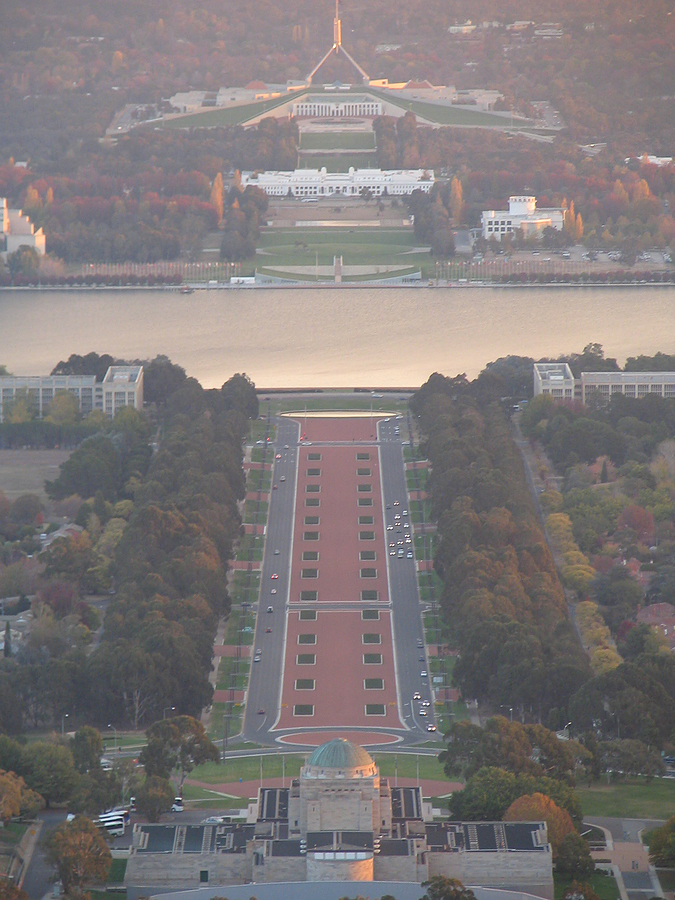
the building in the back fills the one in the front
And on ANZAC day, 25th April, let’s not forget that we still send young men (and women now, too) over to do the dirty work for us all; or at least in our countries’ names. I would like to see Australia’s troops only here for the defence of Australia, and fuck the geopolitics. But it’s usually old men (and the occasional middle aged woman) who make the decisions that cost young men their lives or sanity.
Not to mention the civilians, who have no special day of remembrance. It’s appropriate to remember the dead, but it would make more sense if we didn’t take actions that guarantee that we are making more of them.
Click the black feather to go to the Tuesday poetry hub in the country that contributed the rest of the ANZACs.

Tuesday poem: Cockatoos and a global birthday poem
April 17, 2012
Cockatoos
Yes, we’ve heard their sad repetitions,
the ‘Pieces of eight’, the rote ‘Pretty boys’,
dropped from tired beaks like peanut shells;
birds bored far beyond the thinning bone.
Compulsive as a handwasher who never
satisfies herself against germy armies
(save her hands are gloved in blood,
and cleansed into gauntlets of agony)
the caged bird will repeat this or that,
sigh, then hear that weird word clever,
thrown at his misery like a charity coin,
a beggar at our table of meaning.
But to see them treed, hanging upside-down,
greeting wet wind like a blown umbrella,
yellow winking at sun like a wicked punch-line,
raucous joy a cascade of brassy cunning sax;
this is the true sound of this bossy bright thing.
Why quibble about what they know, or don’t?
A screech floats to ground like a metal bird,
cut with tin-shears by a half-blind drunk,
so gratingly loud that ears are near-shorn.
Cockatoos mar the sky with jagged freedom,
as far from a nightingale’s sweet treacle
as a sudden mouthful of shattered glass.
P.S. Cottier

Muse with beak
Take this poem as a kind of apology for my rampant criticism of Canberra’s weather in my post on April 10th. Cockatoos are one of the many beautiful things about this city. There’s been some world-championship Canberra bashing going on lately, and I wanted to post something in response to the mindlessness of some of those criticisms. I’ve posted a link to this poem before, shortly after it appeared on the web-site of Canadian journal Contemporary Verse 2. Now it’s been in the print edition, and I feel free to publish it here. It came from a competition where participants must pre-register and have 48 hours to produce a poem containing all ten words given in a list. I didn’t enter the more recent competition (last weekend) as I knew I would be writing my line for the Tuesday Poem global poem, which has just been completed.
One ‘prompt’ at a time, please. I found the Tuesday Poem process, writing one line in an unfolding poem written by dozens of poets around the world line by line, very challenging. I was actually very scared as the time for writing my line approached. There were tears. There was a slight spat. But perseverance and wine got me through.
I am actually amazed that something readable, nay, even quite lovely, can come out of a process like this. For me, it was useful in that I had to make my line fit in with the previous parts of the poem. I was worried I could never produce something that gentle. But I did! I just played a straight bat and didn’t shy away from the rather joyous tone that threatened to stump me. To drop the inane cricket metaphor, it’s good to be pushed around a little at times, poetically speaking.
Click this feather, and you’ll be transported to the blog, where you can read the completed global poem, written to celebrate two years of Tuesday Poem.
Tuesday poems: [Mellow fruitfulness]
April 10, 2012
light slanting blinded
sun swoons into evening
winter comes to call

looks good: isn't.
winter cold as Karenin
clicking hard knuckles of frost
please take me to your railway
Yes, welcome to the wonderful city of Canberra, cold little capital town in a warm country. It was a balmy four degrees celsius this morning, and the leaves are falling from the trees in an icy wind. Just lovely. People go around in beanies and scarves saying ‘It’s a bit nippy, isn’t it?’ until you want a giant crab to attack them and cut off their blue fingers and red noses. Why, oh why, was Australia’s capital put here, rather than somewhere warm?
‘Autumn is so lovely.’ Thus spake the idiot at the shops this morning. No it’s not. Autumn is a disgusting harbinger of Winter, which lasts about nine months in Canberra, giving birth to a too short Summer after a dwarf Spring. Then comes another blood-red Autumn. And you walk around hallucinating about Queensland. (Ignoring the beauty of the native parrots and the huge flocks of cockatoos, nestled, perversely, in the introduced deciduous trees.)
Now, for a really lovely unfolding global birthday poem, written in a much more generous spirit than my little anti-Canberra rant, please click this feather, which has fallen onto the screen like a black Autumn leaf! Only birdier.
Tuesday poem: Watching Les Murray
February 21, 2012

That's Les Murray's beer
Watching Les Murray
(I am not making this up)
I went to hear a certain poet
the best known one,
the big one we own.
I wished I could draw
his gentle circles,
his particular infinity.
But I can’t draw.
Though there were pencils.
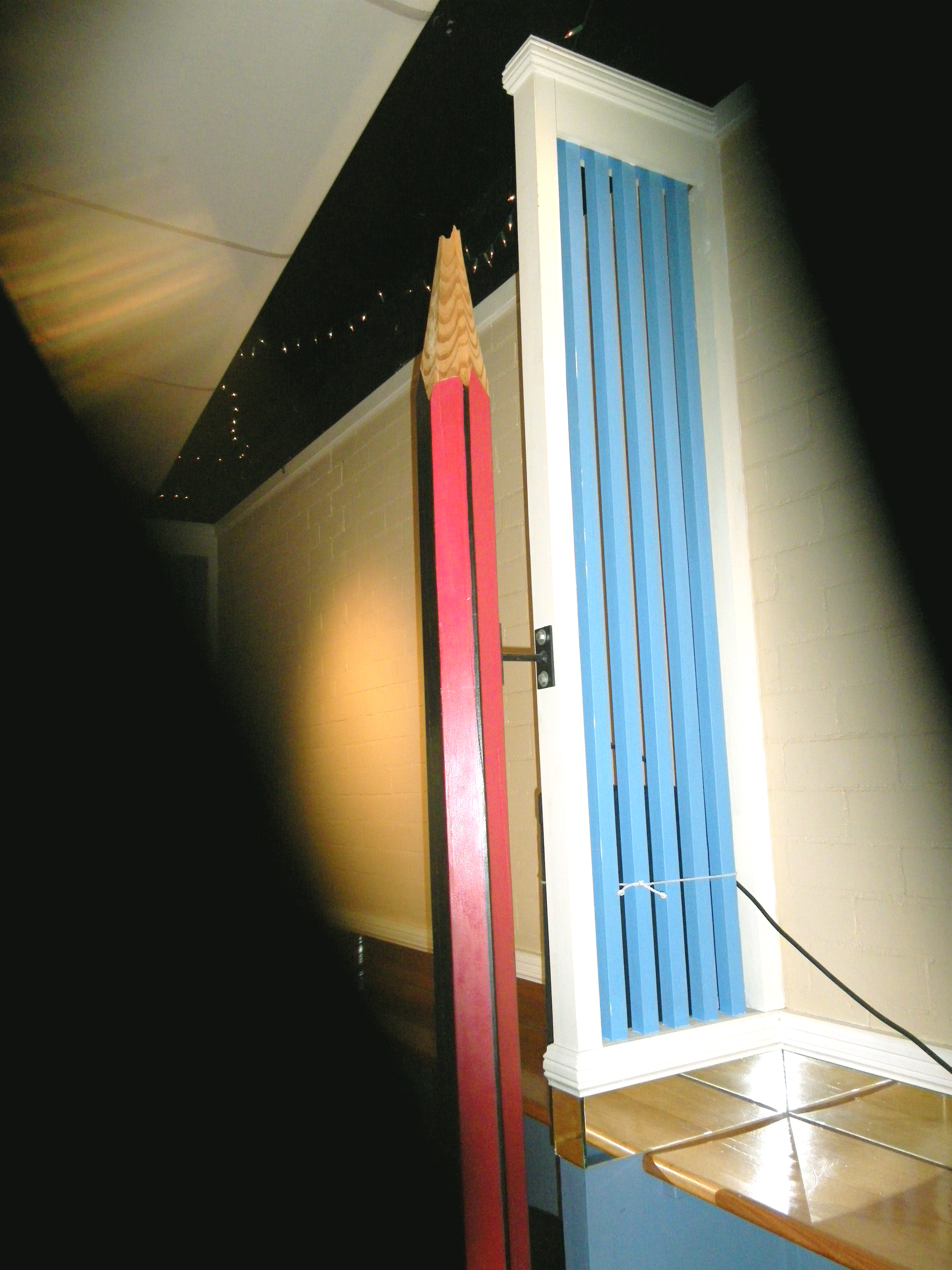
Giant ones. Three metres tall. Red.
I am not making this up.
So I sat and watched Les,
dwarfed by these giant pencils.
And if you don’t believe that,
you won’t believe this;
the place where he read
was called The Gods.
So I sat, a poet from Lilliput,
leaning on a giant pencil,
listening to God, or at least,
his Southern emissary.
I laid wistful eggs on the pencils.
In time, something may emerge,
and help me make something up.
P.S. Cottier
I went to see Les Murray read at the Gods, a café/restaurant on the Australian National University campus on Wednesday, 15th February. Organised, as always, by the indefatigable Geoff Page. There are giant pencils attached to the walls of the café, as you can see in this appalling photo:
Les Murray is so very good as a reader, and I was impressed by how many humorous poems he read last week. I wrote the poem above about four years ago, when I was just starting to make contact with my fellow poets (but before my licence was issued, in the form of my first book). It recalls a much shyer Penelope, sitting in the corner, watching Les read.
Another poet at Les’s reading was Mark Tredinnick, who, as you may know, recently won the Montreal Poetry Prize for his poem, ‘Walking Underwater’. Mark is of course endlessly teased now by cruel people (who shall remain nameless) about how he is spending the prize money, but he takes it very well.

A rather surprised Mark Tredinnick
All in all, this was a wonderful night and it reminded me of just how good poetry can be. As Les Murray said, poetry is strong stuff, and it doesn’t need the crutch of prose to justify itself.
Easy for you to say, Les!

Give it back? Why would I give it back?
If you click on this quill you will be transported to a hub based in New Zealand, and will find Treasure in the form of poetry:
On a totally unrelated issue, my review of ‘A Tingling Catch’ : A Century of New Zealand Cricket Poems 1864-2009, ed. Mark Pirie, Wellington: HeadworX, 2010 has just been published at Cordite. Those who were worried that I was going to write a post without mentioning sport can now breathe more easily. Although watching poets read (and listening to them, too) has aspects of a sport about it.
Poets in the corner
February 2, 2012

not everyone is such a publicist...
No, this is not a post about naughty poets (I told you to stop playing with Augusta, George*!) but about three sculptures that were just unveiled in Canberra’s Garema Place, in an area now known as Poets’ Corner. Judith Wright, David Campbell and A.D. Hope make up the triptych.
I attended the launch, and forgot to take photographs, but anyone interested can follow this link to a Canberra site called The RiotACT see what the sculptures look like. (Not everyone is as forgetful as I am.)
There were excellent poems read at the launch, and an appearance was made by Jon Stanhope, a former Chief Minister of the ACT (sort of a cross between Mayor and School Principal and Premier) who was also Arts Minister. He was supportive of this project.
While many poets pushed for something like this, I left feeling somewhat underwhelmed. Do poets need any memorial outside their words? I don’t think so. And the sculptures (while competent) show the poets at once staring into the middle distance and totally wrapped up in an internal world, with little awareness of the actual world around them. I’m afraid that’s probably how most people see poets, anyway. The idea that the real poets of the world are the dead ones is somehow supported by this type of project, in my opinion.
Byron’s memorial plaque in Westminster Abbey (a somewhat more salubrious location than Garema Place, Canberra) was not installed until the 1969, due to his most naughty reputation. Yet did the reputation of his poetry suffer in the meantime? I don’t think so. The real memorial to these three fine poets can be found in their work. A.D. Hope and David Campbell are represented at the Australian Poetry Library. Judith Wright doesn’t seem to be (copyright?) but examples of her work can be found on the net.
*Byron’s Christian name, as you all undoubtedly knew. And Augusta was his half-sister.
 PS Cottier