Abbott’s booby
December 3, 2011

Sorry if the word ‘booby’ misdirected you here.
This is another poem about Tony Abbott, leader of the Liberal Party in Australia, which is similar to the Conservative Party in England, in many ways. (Here’s the first one published on this blog, relating to climate change.) I recently had a poem about Australia’s attitude to refugees who arrive uninvited published on Eureka Street, remembering the dozens of people who died last year, smashed on the rocks of Christmas Island, an Australian island that is no longer part of Australia for immigration purposes. That poem featured the Christmas Island crab. This one draws links between another native of Christmas Island, Abbott’s booby, and the Leader of the Opposition.
Abbott’s booby
This poem regurgitated itself into my mouth —
a sardine of ill repute, silver little slug.
Abbott’s booby is a native of Christmas Island,
flying around and around.
Its cry is unmelodious,
unfit for any proper idyll.
It picks up stray ideas
and smashes them onto rocks.
(It is in league with the crabs.)
It is a member of the Gannett family.
And there, the useful metaphors run out,
like a big country’s generosity.
For this is a large, graceful bird,
once it has struggled into flight,
and it only troubles the wind.
It is unrelated to the budgie.
It is endangered.
Others, though, are entering their prime.
Oh silver, stinking poem,
shoved down a gagging throat.
P.S.Cottier
Hip hop before hip hop
November 22, 2011
Australia’s loss of frog species is, I believe, the worst in the world. We have lost the gastric brooding frog. The corroboree frog, a species that lives in the few really cold parts of the country, is the subject of directed conservation efforts, yet one wonders how it will cope with climate change. Here is a flyer (hopper?) for a US frog poetry competition, because the problem isn’t confined to Australia. Click to enlarge. Here’s their web-site. I have no connection with this group, but it seems like a good way of encouraging people to think about conservation; I’m putting the poster up at my daughter’s school.
Following below is a poem about a wonderful night when I saw a road covered with frogs in a jumping carpet. It is biologically inaccurate, but I tried to capture the sense of wonder that came with what seemed like a million frogs. I wonder how long we will continue to see this type of natural phenomenon?

Frogs at Durras
We bought a house, feeble fibro shack,
walls thin as a yacht’s, teetering near the sea.
The second time we drove there, slowly,
tentatively, nosing towards ownership,
a rough jagged rain sawed through twilight.
We wondered if the house could survive.
Turning the corner, our eyes jumped,
jerked at a million tiny frogs revelling in rain,
the black streaming street a foaming river.
Each raindrop a watery egg, containing
tadpole, exploding into perfect frog
as it hit the tarmac, transmogrified.
I ran ahead of inching car, scooping throbbing fistfuls,
placing them on nature strip, dividing green from black.
And still they splashed and clung to sodden tar,
each splayed finger reading braille on the rough road;
indecipherable invitation to party, or to climb, perversely,
the dark warm curves of the sudden crushing car.
Three years later, we sit in heat, and await the frogs
never seen since the Walpurgis abandon, that abundant night.
Sometimes we have heard them, piping, tinkling, muted bells,
signalling to each other, chirruping reminders
as they wait beneath rocks, huddled in just damp dark
that all droughts must break. Our house still stands.
P.S.Cottier
Trail of disinformation
August 18, 2011

Must find accent key...
Trail of disinformation
P.S. Cottier
‘Does it really matter, love? After all, we’re talking about a snail, aren’t we? I put down bait for them. Or squash them. It’s them or my veggies.’ Bill smiled, ate a peanut, and drank a little more beer.
‘It’s a special snail. A green one. Tiny.’ I sounded vaguely desperate, and I knew it.
‘But it’s still a snail, green, orange or purple. Rainbow even. I just don’t see the point, worrying about an ugly little bugger like that.’
Bill had hit the nail, or the snail shell, on the head. We were just talking about ‘ugly little buggers’. We wanted to prevent the development of a proposed mine because of the presence of rare miniature green snails, only found in one small pocket of rain-forest. If it were koalas, once the subject of a bounty, we would have been national heroes. A rare species of bird would be understandable. Everyone can see beauty in a bird. But a mollusc is quite a different kettle of fish. Too far beneath our eyes to count. Too near our feet.
It was Jennifer, my best friend and fellow conservationist, who came up with the idea to give our campaign to save the habitat of the endangered snail a certain indefinable…je ne sais quoi.
I knew we were onto a winner the next time I ran into Bill at the pub. He was reading the newspaper, the one that Jennifer had just leaked her ‘secret information’ to. It trembled in his hands. I noticed that he wasn’t smiling, or cracking jokes like errant carapaces amongst the beans. Indeed, he seemed a little angry, a little red in the face.
Bill turned the paper over so I could read the article he had just read. I had to cover my nascent smile as I read:
‘French offer to take Aussie snails
This paper has heard that an offer has been made, through official channels, for all the endangered miniature green snails in the area currently being considered for the development of a new mine to be removed and relocated to France, at the expense of the French Government. It is hoped that the species may prove edible.’
‘Bloody cheek’, said Bill, as he took a long drink of beer. ‘They’ve got their own snails. Poor little buggers. Why do they want to steal ours?’
He’d forgotten his previous comments about pellets and gardening. We had wrapped the miniature green snail in the flag, rendered it as Australian as the kangaroo. We eat them, but that’s different, apparently.
Despite vigorous denials from the French embassy, the story stuck. The public was outraged. Next week, the Government officially declared the snail habitat protected.
And deep in the bush, the tiny snails act out their slimy lives, safe from the development of a new tin mine. And of course, safe from any forced repatriation to the restaurant rich and risky boulevards of Paris.
10 words, 2 days and a flock
June 17, 2011
I recently competed in an interesting competition run by a Canadian journal, Contemporary Verse 2. They give a list of ten words, and punters (who must have pre-registered) have two days to create a poem which contains every word. I sometimes like doing this type of thing as it stops me from falling in a rut, and if the result is less than wonderful, it doesn’t really matter.
I was very pleased to receive an honourable mention, particularly as I found myself writing about cockatoos; hardly something that the average Canadian would see stripping the bark from maple trees on a daily basis, or resting on the antlers of moose. Actually I know that Canada, like Australia, is overwhelmingly urban, so please excuse my tired and narrow stereotypes. (Is there such a thing as a vibrant and broad stereotype?) Here in Canberra cockatoos are as common as sparrows. If not commoner, which is remarkable given how many foreign birds have been released in this country over the past 200 years.
I won’t put the poem up here, as I can’t remember if I granted exclusive e-rights for a time to CV2 (probably not) but here is a link to the poem about cockatoos, imaginatively entitled ‘Cockatoos‘.

Muse with beak
Reading the other poems is fascinating; they are so good that I forgot that they had to contain the magic ten words. And the other poems were mostly urban.
Really urban, not Canberra urban.
100 stories for Queensland
April 30, 2011
What a year for disasters. New Zealand, Japan, the recent storms in the United States, and, of course, the catastrophic floods in Queensland. There are probably many more too, but these four are the ones I’m most familiar with, perhaps because they happened in developed countries, which tend to get more attention in the media. But wherever such events occur, the suffering is undeniably real. And to have a disaster in one’s own country means a certain responsibility to help in some way rests on those who were not affected.
I am very proud to have a tiny story called ‘Beating creativity’ (so flash, if you blink, you’ll miss it) in the book 100 stories for Queensland, which will raise funds for the Premier’s Flood appeal. The book will be launched on 3rd May, and will cost $19.99, and you should be able to order it through your local bookshop soon after that. Or you will be able to go here to find out how to order the book electonically, as a hard copy or an ebook. Here is some more information about the project, from the home site:
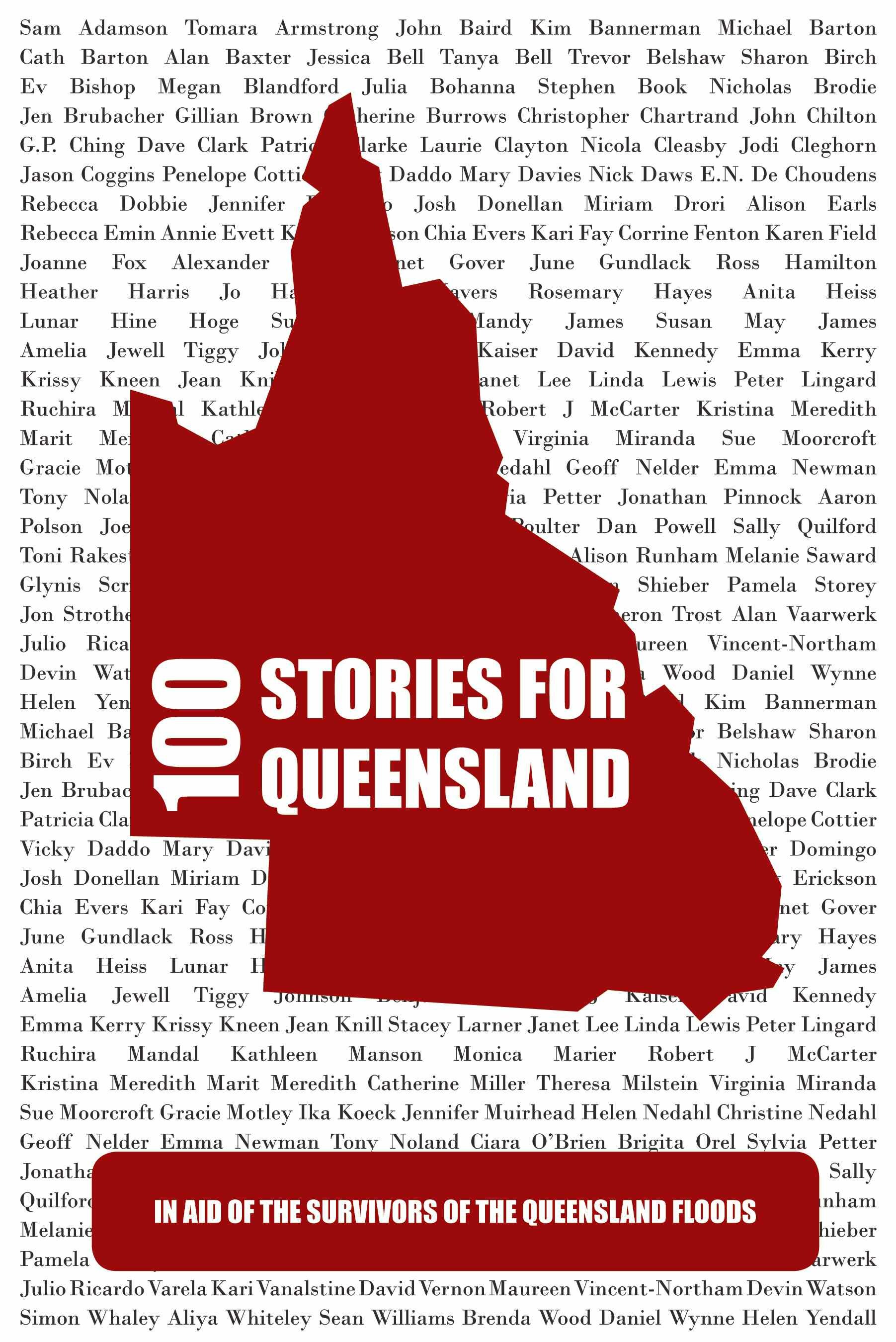
“One hundred beautiful stories. Our stories. When so much was lost or destroyed, this was created. That’s something that can never recede or wash away.” ~ Kate Eltham
CEO of The Queensland Writers Centre
100 STORIES FOR QUEENSLAND has something for everyone, from slice of life to science fiction, fantasy to romance, paranormal to literary fiction. Heart-warming, quirky, inspiring and funny the stories between these covers will lift readers to higher ground.
ISBN (Print): 978-0-9871126-2-0
ISBN (eBook): 978-0-9871126-3-7
Pages: 316
Dimensions: 229x152mm
RRP: A$19.99, US$19.99, ₤9.99, €9.99
UPDATE: There will be a slight delay with the hard copy. Best to go to the 100 stories link in the blogroll (or here) for further details. The hard copy book can now also be ordered from Amazon.
 PS Cottier