Tuesday poem: Written Off by Tim Jones
September 12, 2016
Written Off
They had insured
and re-insured,
still it was not enough.
They hunched over maps,
consulted climate science.
Beachfront property
went with the stroke of a pen:
no possible premium
could insure that level of risk.
And floodplains:
why do people choose to build on them?
Bigger floods, more often: gone.
East Coast farmers, eyeball-deep
in debt, haunted by drought,
desperate to irrigate:
you backed the wrong horse.
Low-lying suburbs, factories
built next to streams:
there is no mercy
in insurance. The numbers speak,
and then there is no mercy.
Tim Jones

This poem is from Tim Jones’s new book New Sea Land, and deals with the effects of climate change in a particularly effective way, using deliberately simple language to describe a practical effect of rising sea levels. It will become impossible to insure all those ‘desirable beachfront properties’, which may soon require scuba gear for inspection.
Tim’s book envisages the further changes that we may see (alongside those that we are already seeing) due to the global experiment that humanity is performing, without a control world to see if it’s a good idea. The effects on the environment and people, both in his own country of Aotearoa/New Zealand, and worldwide, are the subjects of the book. The changes are envisaged in the very title of the book, with the shift from the words New Zealand to something recognisable, but quite different.
If the book’s topic sounds a little overwhelming, the poems themselves are witty, controlled and moving. As someone who is trying to write on the same issues, without breaking into long and unseemly rants, I recommend this timely book to anyone who is concerned with climate change. (Which is a bit like saying anyone who thinks, really.) Personal history is a concern in New Sea Land as well, notably in poems such as ‘The map’, but this is inextricably linked with questions of the treatment, control and ownership of land.
I have had the pleasure of editing a book with Tim, and is intriguing to see how he has moved his political concerns to the centre of his creative practice with New Sea Land. And what a cover by Claire Beynon, showing a person teetering on a thin rope. Tim’s poems are also attempts to find a way of walking the new landscapes we are creating, where loss and uncertainty surround us all.
New Sea Land is available from the publisher, Mākaro Press, who are producing great books. Here are the details:
Title: New Sea Land
Author: Tim Jones
Publisher: Mākaro Press
ISBN: 978-0-9941299-6-3
$25 (NZ).
Bonus Tuesday poem on a Friday
September 9, 2016
God I love this singer and this song:
I trust he’ll be singing in heaven (or, to put it in a slightly different way, to hear this is to be in heaven). In the mean time, here’s a wee poem I wrote about seeing Johnny Cash live, which was first published on Project 365 + 1.
Glastonbury, 1994
When they invent time travel,
whether DeLorean or phone box
I won’t go forward, but back.
There’ll probably be strict laws
about interference
and the paradox
as explored in science fiction
forever, and yet, a visit
to Glastonbury in ’94
surely wouldn’t be a threat,
or trigger Bradbury’s
butterfly effect?
(Unless someone already did,
and that explains the Trump.)
I’d blend into the heaving crowd,
a very happy, sunburnt piggy.
I want to see Johnny Cash live.
I want to watch the Man in Black
and hear him walk the line.
’69 at San Quentin
is out of the question,
but ’94 will do fine.
A simple time machine and off she went,
pausing momentarily to buy a tent.
P.S. Cottier
Notes: The ‘butterfly effect’ mentioned here refers to the short story ‘A Sound of Thunder’ by Ray Bradbury, in which the accidental killing of a butterfly in the distant past results in a very different future world, not least in political terms.
Apparently it was hot at Glastonbury in 1994, which I find hard to believe.
(King James Version, by the way.)
Tuesday poem: Between smug and shocked
September 6, 2016

Between smug and shocked
she clutched at anthologies —
straws in a cocktail
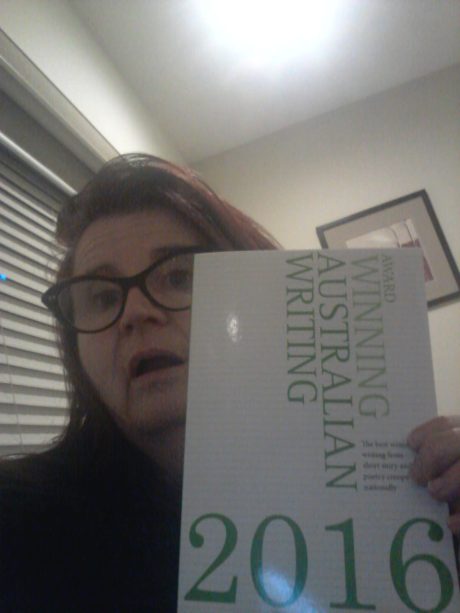
The anthology being clutched by the poet, drunk on literature and (mostly) wine was launched in Melbourne last week. I read at the launch in the Athenaeum Library, and Melbourne Books arranged a really cool event. I had a great champagne beforehand at the sort of bar Melbourne does so well, also in Collins Street, as I hate to read totally sober.
Good to meet the editor/mixologist of Award Winning Australian Writing, Chloe Brien, and some fellow ingredients. (I am usually an olive, although lemon twist or even crème de something unspeakable is not unknown.)
I also attended the Australian Catholic University’s Poetry Awards, and you can read the results here. They also produced a book of the short-listed entries, but I am unsure if that is available for sale.
AWAW would make a really good gift, as everyone will like at least some of the work included. I’ve just started reading the anthology, and there’s a lot to appreciate. Particularly the poem that starts on page 203, she said modestly. Everyone will love the taste of that.
I was also just short-listed and published in the Hunter Writers Centre Grieve anthology, and look forward to reading that one as well. I won’t probably use so many alcohol metaphors about that anthology.
Tuesday Poem: Perfect words
August 29, 2016
Perfect words
Sometimes they reach out
caress with syllable fingers —
egregious is my long term love
half egret feathers with the jus
noise saucing the end,
despite the meaning
or because it’s such a better way
to say doubleplusbad.
Gnarly enchants, with that
drowning g, wiping out
in the endless surf of the ee.
What wetsuit could protect,
what board shorts deserve
the sweet yet egregious sea,
with the tincture of shark grin
and the promise of release?
P.S. Cottier

That illustration is most egregiously gnarly, and not AMA approved.
***
Here’s a photo in a different key, of Susan Hawthorne and Lizz Murphy who were participants in a discussion on The Poetics of Politics which was part of The Canberra Writers Festival. I moderated the session on Saturday, and it went well, I think. We covered quite a lot of ground, and read several poems. Later I thought about the event, and I realised that all the speakers and questioners had been women, which was a first, in my experience, at a mixed gender event.
Here are Lizz and Susan at Tilley’s après the panel. They both ate. I drank, and had a quiet evening watching horrendous Swedish murders being solved Nordically.

And here’s another one before the wine at the end of the event itself; thank you Gina Dow.

Too busy Toosday
August 22, 2016
I apologise profusely for no original poem today. I am a tad busy at the moment.
Thursday 25th at 7.30, I am reading poetry at Manning Clark House, Tasmania Circle, Griffith. Many of the poems will have first been published on this very blog, or at Project 365 + 1. I will be reading for about 30 minutes, as will Hazel Hall, the other reader. There is an entry fee of $10, I think, which covers wine, some small items of food and the wee literary stuff.
On 27th August (Saturday) I’ll be moderating a discussion on The Poetics of Politics, at the National Library of Australia (a big building by the lake). The immoderators/speakers are Lizz Murphy and Susan Hawthorne, and it happens at 12pm, just after a launch of novelist Kaaron Warren’s new book, The Grief Hole, at the very same library at 11am.
On the 31st August I’ll be going to the launch of Award Winning Australian Writing in Melbourne, and reading a poem, and then attending the announcement of the Australian Catholic University Poetry Competition results the next day. I am short-listed for that, but I don’t think I won a prize this year, for various reasons. Still, they produce a really nice collection of poems short-listed in the competition.
Then I will hopefully get some writing done. Plus I’ll soon be proofreading a new chapbook of poems. More about that later.
 PS Cottier