Tuesday poem: Faith took a holiday
November 16, 2016
Faith took a holiday
He hitched down the Hume, or up;
he didn’t tell me. Faith has no fear
of murder, or everyday sleazes
and their boring imprecations.
It’s the ones left behind
who tend to fret. What if,
we say, and perhaps…
as if perhaps isn’t Faith
flipped like a decisive coin,
standing on his head.
As if as if isn’t
closer to for sure
than some might like it to be.
Faith rang me from Melbourne,
(so it was down the Hume)
and said he wanted to look around
a bit longer; catch the trams.
He too remembers
the excellent days of conductors,
with their magical brown bags.
Even Faith feels regret
at the passing of old days;
the spinning of so much
towards the expansive sun
of interconnected drivel.
There is a grace
in not knowing too much,
he said, though Faith would say that,
I suppose. That’s his job.
A kind of conductor
unseen in any tram,
on any route, whatsoever.
Faith will return soon;
I can hear the jingling
just at the edge of thought
and the tune is one
I almost remember.
The brown bag of my
restless, overloaded brain
awaits his presence,
and will sling itself, eager,
over his patient arm.
P.S. Cottier
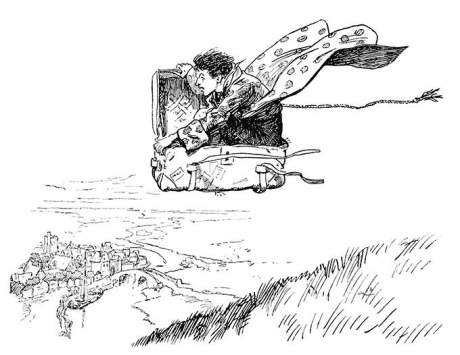
Like a lot of the world, I’m suffering the post-US election blues, and almost didn’t post this week. The clever amongst you will have noticed that it is Wednesday, not Tuesday, and the weekly schedule has been disrupted. But poetry is fairly unstoppable!
For my overseas readers, the Hume is the major highway linking Melbourne and Sydney. Canberra is just a wee drive from it.
I have no idea why Faith is male in the poem. Perhaps it was some association with Christ? And my phone has just died, which has me longing for the ‘interconnected drivel’ which I decry in the poem, even if I’m avoiding news sites at the moment.
Tuesday poem: (All written out)
October 24, 2016
All written out —
ink pushes no poems
flat-lining
P.S. Cottier

My brain, if not my heart, is convinced that the year is ending, even if it’s only late October. I have been running around too much to do the poem thing enough. Definitely looking forward to taking a break in December to jump start the brain. Must buy jump-leads.
Or vodka, which is nature’s jump-lead.
Tuesday poem: No streets, or maps to find them
October 18, 2016
It’s by link to Tim Jones’s site, where he posts a poem from my new chapbook Quick Bright Things: Poems of Fantasy and Myth. He also gives some commentary on the poem and the book, which is cool as a sea cucumber. (The poem is about a sunken city, hence the sea imagery creeping in there. Or sliding, or however sea cukes move.)
I was thinking of posting an appropriate Atlantis type image, but here instead is the cover of the book once again, with the cricketing fairy drawn by Paul Summerfield. You can buy a copy here.

Various poetic items: Including ruptures in the space-time continuum, and a poem.
September 25, 2016
Firstly, if you want to hear me talk about poetry at some length, and read a few poems, please go to the Verity La podcast. Michele Seminara and Alice Allan are the interviewers/fellow discussants, which means that they like hurling questions like flattened orbs, but in a polite kind of way. I am just getting up the courage to listen to myself.
Secondly, I was in a most excellent night at The Salt Room on Friday 23rd September. I was the first reader, armed with lectern, and stayed rooted to the spot, even if my poetry didn’t. I read about fantastic creatures and climate change.
Then came Miranda Lello, who read a long poem, or poetry sequence, called Election Day 2086 (a memoir, a map), which she had written for the reading. She also made a zine specifically for the night. The election described in very grounded in Canberra, but a Canberra that stands as a kind of ghost of the current one. Black Mountain Tower
‘…rises from the forest pointing
To our neo-retro-future selves
Empty for decades beaming signals to the stars –
Stories of school groups’ noisy chattering
The cruelty of children…
She is a great reader/performer, and I enjoyed her travels in time, and the way she recasts the very familiar in a slip of unfamiliarity. She needs no magic call box. Or lectern, either!
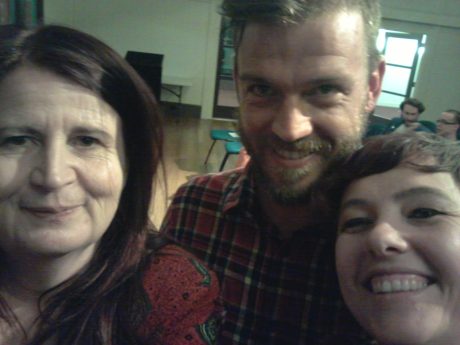
Scott Wings also dealt with time, but for me his use of space was the most remarkable thing; his crawling up a tree by lying on the floor, his pacing the room, so that even the shyer people up the back were made part of the performance. If you gave Scott a lectern, I think he’d probably use it in some unexpected way. His work is quite moving, too, dealing with aspects of his life and how he came to poetry. Here we all are:
Joel Barcham and Andrew Galan were their usual form of excellent, too, and I am very happy to have been asked to read at The Salt Room.
Yesterday (and thirdly) I went up to Sydney for the inagaural first Poetry at Sawmillers reading, and enjoyed the brief taste of the lower north shore. Some really good poetry read and performed, and I’ll post a link to the winner’s poem if it is published. For me, sitting at a local pub with a view of a bay and a bridge, sipping booze was so pleasant I can imagine another poet, say SP (“Sippy”) Cottier, who would miss the reading and simply stay on the terrace, sunning herself like one of the lizards living under the succulents on the deck who have no idea that they have a view worth about 3.5 million dollars.
But I am not that poet, and really enjoyed reading my poem, which I present forthwith:
7 ways to look at a sculpture
Firstly, it seemed a frozen poem,
which I read in different drafts
as I skirted around it.
Then it was time captured,
as if to trap the watchers,
and so release us from fervent rush.
By Wednesday I saw it more
as a mere mirror to catch
any cracked thought I threw at it —
but the next day it restated
its being as a question, set to
disrupt our certainties with what?
Friday, it seemed to push up the sky,
a small, persistent fist clenched
against wind and mess and change —
but this changed on Saturday.
The grass seemed to give birth to it
as tulip, rocket and shining tree,
which unfurled into beauty
on the stretching, languid, seventh day,
an exclamation, an endless ah!
P.S. Cottier
Now I am off to stare at the Verity La site to see if I’m brave enough to listen to me.
***I have also received my new chapbook, and will post about that very soon. That’s a fourthly.
UPDATE: I listened to the podcast and I’m not as inarticulate as I had feared. I particularly like the discussion on ecopoetry and climate change.
Tuesday poem: Written Off by Tim Jones
September 12, 2016
Written Off
They had insured
and re-insured,
still it was not enough.
They hunched over maps,
consulted climate science.
Beachfront property
went with the stroke of a pen:
no possible premium
could insure that level of risk.
And floodplains:
why do people choose to build on them?
Bigger floods, more often: gone.
East Coast farmers, eyeball-deep
in debt, haunted by drought,
desperate to irrigate:
you backed the wrong horse.
Low-lying suburbs, factories
built next to streams:
there is no mercy
in insurance. The numbers speak,
and then there is no mercy.
Tim Jones

This poem is from Tim Jones’s new book New Sea Land, and deals with the effects of climate change in a particularly effective way, using deliberately simple language to describe a practical effect of rising sea levels. It will become impossible to insure all those ‘desirable beachfront properties’, which may soon require scuba gear for inspection.
Tim’s book envisages the further changes that we may see (alongside those that we are already seeing) due to the global experiment that humanity is performing, without a control world to see if it’s a good idea. The effects on the environment and people, both in his own country of Aotearoa/New Zealand, and worldwide, are the subjects of the book. The changes are envisaged in the very title of the book, with the shift from the words New Zealand to something recognisable, but quite different.
If the book’s topic sounds a little overwhelming, the poems themselves are witty, controlled and moving. As someone who is trying to write on the same issues, without breaking into long and unseemly rants, I recommend this timely book to anyone who is concerned with climate change. (Which is a bit like saying anyone who thinks, really.) Personal history is a concern in New Sea Land as well, notably in poems such as ‘The map’, but this is inextricably linked with questions of the treatment, control and ownership of land.
I have had the pleasure of editing a book with Tim, and is intriguing to see how he has moved his political concerns to the centre of his creative practice with New Sea Land. And what a cover by Claire Beynon, showing a person teetering on a thin rope. Tim’s poems are also attempts to find a way of walking the new landscapes we are creating, where loss and uncertainty surround us all.
New Sea Land is available from the publisher, Mākaro Press, who are producing great books. Here are the details:
Title: New Sea Land
Author: Tim Jones
Publisher: Mākaro Press
ISBN: 978-0-9941299-6-3
$25 (NZ).

