Tuesday poem: My selfie on Calvary
November 3, 2014
My selfie on Calvary
I had to squat,
haul up his head
but I like the way
the thorns look like an effect —
‘trembling halo’ —
and the crimson
just nailed it lol
P.S. Cottier
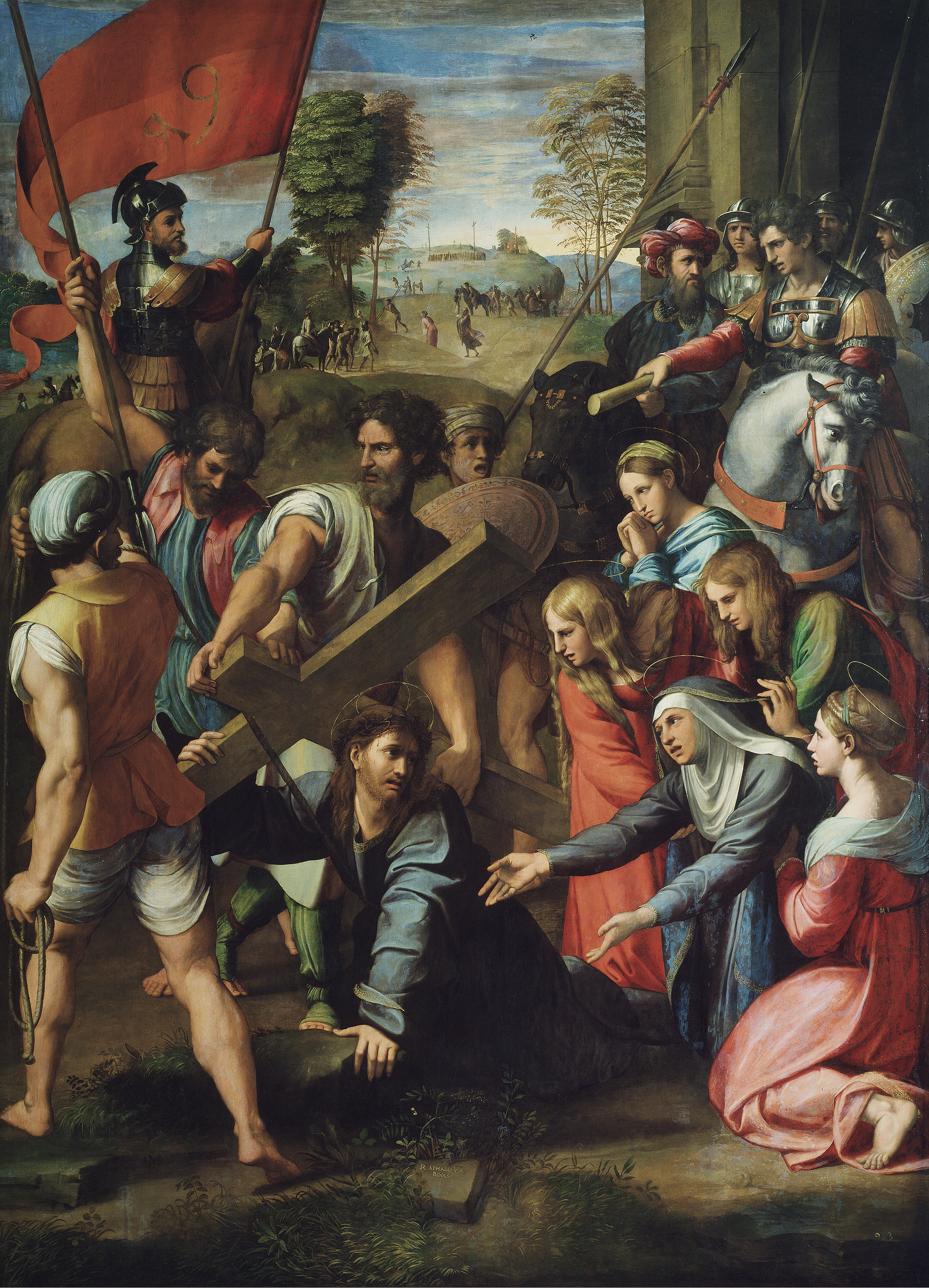
I was shocked, the other day, to hear of people taking selfies in front of car accidents, and the idea that people would take a selfie as Jesus carried the cross came to me. The poem attempts to capture this spirit, in appropriate flat-pack language.
Let’s face it, some people would climb up over someone on the cross to get the right photo. Not that that ability to ignore suffering is new; remember the soldiers gambling under the cross as Christ died. But the need to capture our images all the time, and the idea that sensation of viewing the images overcomes compunction is a new manifestation of this way of thinking, it seems to me. An unlovely mix of vanity and cruelty, which is to art (see Raphael above) what Twitter is to literature.
Pornography and self perception are becoming more and more linked, and the production of images through any means is approved.
Now I promise to be new light hearted next time.
Light as this feather. Tap it and read more poetry:

That image is sometimes not appearing properly, but please, click anyway.
Not so egregiously slack
October 30, 2014
I really have been absent from my blog for about two weeks now, which is virtually unprecedented. ‘Virtually unprecedented’ is a pretentious way of saying I am usually not lazy like that. But I have been busy, judging other people’s poetry.  That image is very dignified, whereas the process is somewhat more fraught. ‘Fraught’ is a slightly pretentious way of saying difficult. The whole issue of judging poetry throws one back to basics: Why me? What makes a poem good? It is easy to spot the bad poems in a Big Pile. They may use obvious rhyme to the extent that a rhyme seems to be the only point of each line. (A bit like that sentence, but even rhymier.) They may dwell too obviously on the poet him or herself (all the poems to be judged are anonymous, of course, so one does not know the gender of the entrant). I actually like some poems in which the process of writing itself is dealt with, if they are amusing or surprising; not if they are turgid or caught up in an unreflective notion of genius. A good poem should surprise and take risks. It should not use the occasional ‘poetic’ word as seasoning for a balefully plain meal. Somewhere between pinch, stroke and slap we find the Good Poem, strutting herself like a green flamingo, all swerve and flap and tingle.
 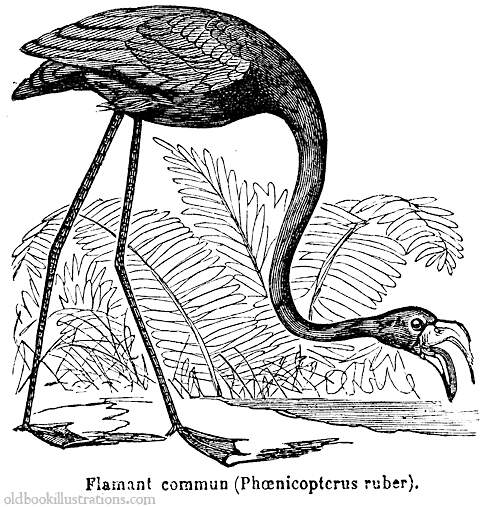 There you have it; a Good Poem describes an unusually feathered tall bird that tastes like sherbet. Having cleared that up, and finished judging a contest in which there were just too many lovely flamingos, I can move on to something different.
***
A very interesting anthology is currently being prepared for publication in 2015. Here are the details: http://www.abhayk.com/p/global-poetry-project.html Abhay K., Indian poet and diplomat, is editing a collection of poems on capital cities. One for each capital city, I think. I just found out that my poem has been accepted for Canberra. This will be the most international publication that I have been lucky enough to be part of, with poets from Tehran to Jakarta to Paris to Lima included, with 196 or so more. Very exciting indeed!
***
I am struggling to find the time to work on assembling a new manuscript of poems. So please, dear reader, forgive the absence of an actual poem here this time. I will remedy that in the near future. Which is a pretentious way of saying keep reading.
Tuesday poem: Peripheral vision flicker (A poem found at Conflux)
October 13, 2014
Peripheral vision flicker
(A poem found at Conflux)
That subterranean process
alien or not alien
everyone is pretending
peripheral vision flicker
she can smell if you’re sad
more oxygen than carbon
prone to sooting
the aroma of porcelain
observe the strange world!
I was actually swooning
wouldn’t send a trunk story
we churn through them
faffing around before
a source of buoyancy
sketchy with world building
arrogant rockstar scientist
no socks in fantasy land
bounce off the person you are
every village is a city
chunky unspeakable matter
just people in an environment
herbivore men
arcane and hideous process
when we have wings
tend not to rhyme
a paisley black hole
P.S. Cottier

I love not listening properly, or even listening improperly…that is, just hearing little sound-nuggets (or sense nuggets) and recording them. Here we find some little phrases from a science fiction convention held in Canberra a week ago, joined together and called a poem. It’s more a peripheral sound flicker, to adapt the title to my nefarious ways.
Have I no decorum?
If you want proper poetry that may even make sense, may I suggest that you press this feather, and be beamed sideways to New Zealand and in other directions to other parts:
Tuesday poem: Last leaf
October 7, 2014
Last leaf
Does the tree despise
the last leaf
clinging to a twig
in brown nostalgia?
Is it the wind,
or thin fingers flicking
that drives it on,
and out, at last?
Eager ground calls it —
shepherds it down,
corralling nitrogen;
sequestering damp.
P.S. Cottier
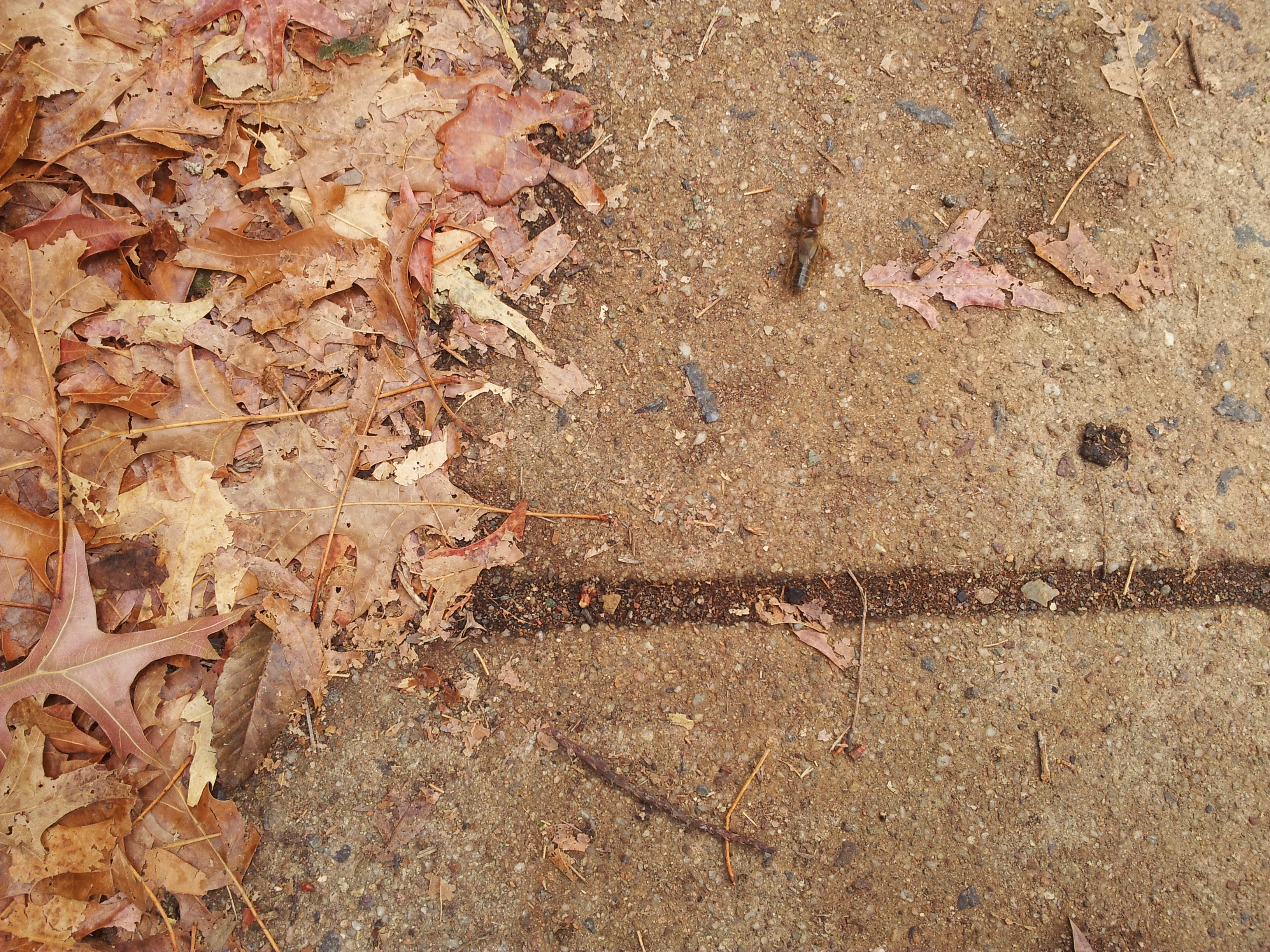
A surprisingly non-speculative poem for one who spent all weekend at a science fiction convention. And a surprisingly autumnal one for the beautiful spring weather in which it was written.
I was on two panels at the Conflux convention: one on editing anthologies and one on poetry. I may write a longer post about it when the energy returns. As the tree said to the last leaf.
Soon I should be receiving the entries in the ACT Writers Centre Michael Thwaites Poetry Prize for my judging pleasure. Second competition I’ve judged in a month, and the third this year. I may write a longer post about it…you know when.
Click this feather for further excellent poetic mulch:
Tuesday poem: Gabriel Grub’s Song by Charles Dickens
September 16, 2014
Brave lodgings for one, brave lodgings for one,
A few feet of cold earth, when life is done;
A stone at the head, a stone at the feet;
A rich, juicy meal for the worms to eat;
Rank grass overhead, and damp clay around,
Brave lodgings for one, these, in holy ground!

This little song appears in The Pickwick Papers, and was therefore the work of a very young Dickens. It is part of a very long history of funny, morbid gravediggers in literature, and is no doubt intended to trigger memories of Hamlet. The illustration, by Hablot Knight Browne, captures this beautifully. It is well worth looking at his other illustrations on Wikimedia Commons.
Gabriel Grub is like a prototype for Scrooge; the miserable man is reformed by exposure to a goblin, just as Scrooge will later be changed by the ghosts. Even in this early book (1836-37) we see how Dickens loved playing with names; a sexton called Grub singing of worms is just wonderful. Grub, unlike Scrooge, is often very drunk.
Asking if Dickens was a great poet is like judging an elephant on its ability to tap dance. It really is missing the whole point of the creature.
I don’t know if any other poets have posted poems about death, but I shall shortly press this feather, dropped by a hungry crow, and find out:
 PS Cottier