Various poetic items: Including ruptures in the space-time continuum, and a poem.
September 25, 2016
Firstly, if you want to hear me talk about poetry at some length, and read a few poems, please go to the Verity La podcast. Michele Seminara and Alice Allan are the interviewers/fellow discussants, which means that they like hurling questions like flattened orbs, but in a polite kind of way. I am just getting up the courage to listen to myself.
Secondly, I was in a most excellent night at The Salt Room on Friday 23rd September. I was the first reader, armed with lectern, and stayed rooted to the spot, even if my poetry didn’t. I read about fantastic creatures and climate change.
Then came Miranda Lello, who read a long poem, or poetry sequence, called Election Day 2086 (a memoir, a map), which she had written for the reading. She also made a zine specifically for the night. The election described in very grounded in Canberra, but a Canberra that stands as a kind of ghost of the current one. Black Mountain Tower
‘…rises from the forest pointing
To our neo-retro-future selves
Empty for decades beaming signals to the stars –
Stories of school groups’ noisy chattering
The cruelty of children…
She is a great reader/performer, and I enjoyed her travels in time, and the way she recasts the very familiar in a slip of unfamiliarity. She needs no magic call box. Or lectern, either!
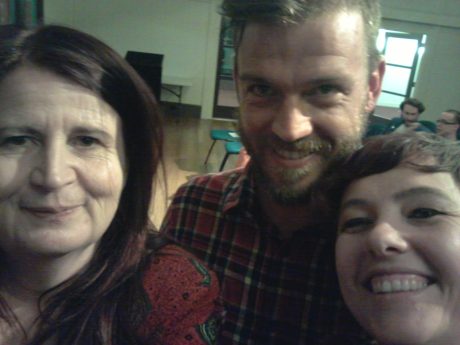
Scott Wings also dealt with time, but for me his use of space was the most remarkable thing; his crawling up a tree by lying on the floor, his pacing the room, so that even the shyer people up the back were made part of the performance. If you gave Scott a lectern, I think he’d probably use it in some unexpected way. His work is quite moving, too, dealing with aspects of his life and how he came to poetry. Here we all are:
Joel Barcham and Andrew Galan were their usual form of excellent, too, and I am very happy to have been asked to read at The Salt Room.
Yesterday (and thirdly) I went up to Sydney for the inagaural first Poetry at Sawmillers reading, and enjoyed the brief taste of the lower north shore. Some really good poetry read and performed, and I’ll post a link to the winner’s poem if it is published. For me, sitting at a local pub with a view of a bay and a bridge, sipping booze was so pleasant I can imagine another poet, say SP (“Sippy”) Cottier, who would miss the reading and simply stay on the terrace, sunning herself like one of the lizards living under the succulents on the deck who have no idea that they have a view worth about 3.5 million dollars.
But I am not that poet, and really enjoyed reading my poem, which I present forthwith:
7 ways to look at a sculpture
Firstly, it seemed a frozen poem,
which I read in different drafts
as I skirted around it.
Then it was time captured,
as if to trap the watchers,
and so release us from fervent rush.
By Wednesday I saw it more
as a mere mirror to catch
any cracked thought I threw at it —
but the next day it restated
its being as a question, set to
disrupt our certainties with what?
Friday, it seemed to push up the sky,
a small, persistent fist clenched
against wind and mess and change —
but this changed on Saturday.
The grass seemed to give birth to it
as tulip, rocket and shining tree,
which unfurled into beauty
on the stretching, languid, seventh day,
an exclamation, an endless ah!
P.S. Cottier
Now I am off to stare at the Verity La site to see if I’m brave enough to listen to me.
***I have also received my new chapbook, and will post about that very soon. That’s a fourthly.
UPDATE: I listened to the podcast and I’m not as inarticulate as I had feared. I particularly like the discussion on ecopoetry and climate change.
Tuesday poem: You can’t stand outside, and reading this Friday
September 19, 2016
You can’t stand outside
Those small hems of grass at the edge
of the pavement, skirting road and house —
nature strips, we call them.
As if nature were a thin green line
of easy demarcation,
a quaint decoration for real estate.
Long home to droops of grass,
and limp advertising leaflets,
spat from bored letterboxes
like soggy swear words,
promising a paradise of credit.
But now backs swell,
bums are fleshy pumpkins,
bending over to tend
your actual pumpkins.
Vegetable patches add a swatch
of nature to the nature strips,
cultivated as they may be.
They’re small, these crops; pea small.
Peas placed under the mattress
of the market — hardly enough
to wake it from slumber.
That lazy princess dozes on,
dreaming the unseemly lives we live in.
And yet, as my neighbour said,
mulching with soggy leaflets —
if you can’t stand outside things,
at least you can get outside
and grow a few things.
She turned her strong back,
tending to tumescent zucchinis,
and the impatient tomatoes
she will decant into twenty hungry jars.
She’ll give some jars away,
or swap them for flowers or beans
in a cool, vegetable anarchy.
(Her recipe? Well, I would attach it,
but that’s one thing she just won’t share.)
The Princess shifts in her sleep.
The pumpkins are replete with seed.
P.S. Cottier

This poem comes from a proposal to allow people to grow vegetables and other smallish plants on the nature strips outside their houses in Canberra, which are now meant to remain as purely grass and government street trees. A great idea to allow a bit of cultivation of the nature strips, as every bit of produce grown at home reduces the need for buying goods shipped in carbon emitting vehicles. Plus, it’s fun. And it gives capitalism a wee tickle, a bit like a green fairy armed with a budgie’s feather.
The proposal was going to be formalised in Saptember, but has been put off to next year. I do hope the ACT government allows this change, and has not been dissuaded by whinging about the possibility of someone impaling themselves on asparagus spears or knocking themselves on the head by slipping onto a pumpkin. Of course, ensuring that footpaths are accessible to all is important; but some other people just whinge about any change, however minor. You know you live in a fairly safe city when people get worked up about beans possibly detracting from the ambience.
The poem above is therefore an imaginary creation of the Vegetable Patches of The Future.
🍅🍆🍅🍆🍅🍆🍅🍆🍅🍆🍅🍆🍅🍆🍅🍆🍅🍆🍅🍆🍅🍆🍅🍆🍅(I am getting bored)🍐
In my immediate future (Friday) is a reading at The Salt Room. Here are the details:
FRI 23 SEPTEMBER
The Salt Room
Main Hall, Gorman Arts Centre
7.30pm to 10.30pm
Presented by Ainslie and Gorman and BAD!SLAM!NO!BISCUIT!, The Salt Room is a showcase of the finest ACT, interstate and international writers and performers around. Featuring Miranda Lello, P.S Cottier, and Scott Wings. 7.30pm.
Cost: $10 full, $5 concession available at the door.
There is a bar. And hopefully I will have received my new chapbook of fantasy poems to sell by then! As crunchy as a carrot and as magical as an eggplant. (A vegetable that divides opinion like an avocado, I find. And good luck growing those green lovelinesses in Canberra!)
UPDATE: Just heard that a poem I wrote has been shortlisted in the Poetry at Sawmillers prize, part of the Sculpture at Sawmillers event at McMahons Point in Sydney, so I’ll be popping up to read it on Saturday afternoon. Should be fun, once I get there.

Tuesday poem: Written Off by Tim Jones
September 12, 2016
Written Off
They had insured
and re-insured,
still it was not enough.
They hunched over maps,
consulted climate science.
Beachfront property
went with the stroke of a pen:
no possible premium
could insure that level of risk.
And floodplains:
why do people choose to build on them?
Bigger floods, more often: gone.
East Coast farmers, eyeball-deep
in debt, haunted by drought,
desperate to irrigate:
you backed the wrong horse.
Low-lying suburbs, factories
built next to streams:
there is no mercy
in insurance. The numbers speak,
and then there is no mercy.
Tim Jones

This poem is from Tim Jones’s new book New Sea Land, and deals with the effects of climate change in a particularly effective way, using deliberately simple language to describe a practical effect of rising sea levels. It will become impossible to insure all those ‘desirable beachfront properties’, which may soon require scuba gear for inspection.
Tim’s book envisages the further changes that we may see (alongside those that we are already seeing) due to the global experiment that humanity is performing, without a control world to see if it’s a good idea. The effects on the environment and people, both in his own country of Aotearoa/New Zealand, and worldwide, are the subjects of the book. The changes are envisaged in the very title of the book, with the shift from the words New Zealand to something recognisable, but quite different.
If the book’s topic sounds a little overwhelming, the poems themselves are witty, controlled and moving. As someone who is trying to write on the same issues, without breaking into long and unseemly rants, I recommend this timely book to anyone who is concerned with climate change. (Which is a bit like saying anyone who thinks, really.) Personal history is a concern in New Sea Land as well, notably in poems such as ‘The map’, but this is inextricably linked with questions of the treatment, control and ownership of land.
I have had the pleasure of editing a book with Tim, and is intriguing to see how he has moved his political concerns to the centre of his creative practice with New Sea Land. And what a cover by Claire Beynon, showing a person teetering on a thin rope. Tim’s poems are also attempts to find a way of walking the new landscapes we are creating, where loss and uncertainty surround us all.
New Sea Land is available from the publisher, Mākaro Press, who are producing great books. Here are the details:
Title: New Sea Land
Author: Tim Jones
Publisher: Mākaro Press
ISBN: 978-0-9941299-6-3
$25 (NZ).
Too busy Toosday
August 22, 2016
I apologise profusely for no original poem today. I am a tad busy at the moment.
Thursday 25th at 7.30, I am reading poetry at Manning Clark House, Tasmania Circle, Griffith. Many of the poems will have first been published on this very blog, or at Project 365 + 1. I will be reading for about 30 minutes, as will Hazel Hall, the other reader. There is an entry fee of $10, I think, which covers wine, some small items of food and the wee literary stuff.
On 27th August (Saturday) I’ll be moderating a discussion on The Poetics of Politics, at the National Library of Australia (a big building by the lake). The immoderators/speakers are Lizz Murphy and Susan Hawthorne, and it happens at 12pm, just after a launch of novelist Kaaron Warren’s new book, The Grief Hole, at the very same library at 11am.
On the 31st August I’ll be going to the launch of Award Winning Australian Writing in Melbourne, and reading a poem, and then attending the announcement of the Australian Catholic University Poetry Competition results the next day. I am short-listed for that, but I don’t think I won a prize this year, for various reasons. Still, they produce a really nice collection of poems short-listed in the competition.

Then I will hopefully get some writing done. Plus I’ll soon be proofreading a new chapbook of poems. More about that later.
Tuesday Poem: A short wander through the head of a poet
August 15, 2016
A short wander through the head of a poet
‘I am finding a lot of this poeting business is learning how to hack your own thinking.’ (SB Wright)
Axing myself near every day
with nouns like blades
or is that the verbs,
sneaking and executing
behind my weary back?
Adverbs are the worst,
obviously, and I try
to expel them from thought.
Does a bear? Does a bear?
It doesn’t work, naturally.
My head is a jungle
of the old Tarzan sort,
and even a cunning machete
won’t clear a way,
despite avid hacking,
and the sticky tape I use
to reattach feckless fingers.
I will staple a handy volume
to my brow, perhaps
one that tells how
to write truth slant,
like Dickinson E,
and to be picaresque,
and appropriately Byronic.
A coupling that, of itself,
will cause sparks to leap
as if one were to jump start
an elderly ute gone bad.
Now, where are my cables?
Is this an Allen key
I see before me?
Statbadgers of the world unite!
Pick up your tongues like sticks,
and lick the befuddlement of brains
from cracked and gnarly windows.
P.S. Cottier

SB Wright is a poet who, this year, is detailing the process of writing and learning more about poetry at his blog. It is well worth a look. He is far more honest about the struggle involved in writing than many of us, particularly when it comes to how he manages a ‘real job’ (my words) while trying to write. He posts actual numbers, written by helpful Statbadgers for those who like that type of thing.
Occasionally he also posts one of the results of these struggles, aka a poem, and he frequently directs you to poems by others, or books and talks about poetics. (Poetics is like choreography, but involves people who are a lot more clumsy.)
SB Wright is not plagued by adverbs in his poetry, incidentally. That was poetic licence.
 PS Cottier