Tuesday poem: Deep sea vents
September 16, 2025
Deep sea vents
Starfish cluster like orange suns,
clinging to the bewitching vent
whose toxic warmth allows them life.
Ghost-fish haunt these black depths,
blind, or carrying lanterns made
from their own anaemic flesh.
They flash like deep sea paparazzi.
Aliens live far beneath our boats
without a breath of solar light.
Planets of giant long-legged crabs,
and copycat worms in tubes near
long boiling steaming lava chimneys.
Smoking is definitely
good for their health.
PS Cottier

Alphonse de Neuville, illustration to Vingt mille lieues sous les mers
Poem: Colour in winter
April 22, 2024
Anyone who wears a black puffer jacket,
so sensible and restrained,
should be choked on their own down
— or that of the now-naked ducks —
and puffed up like a puffer fish, till they fly
away like so many clouds of doom.
Why add to bleakness?
Match yellow with aubergine,
orange and berry crimson.
Clash those hues like cymbals
in the smug faces of constraint.

PS Cottier


Now I could have revived the title of my series of "Nasty little poems" for that, as it's a tad cruel.  It's not aimed at those with no choice as to what they wear, but at the sensible middle class.  There's something about the temperature dropping in Canberra that makes people dress in black and grey.  Way back when I lived in Melbourne I used to wear a lot of black, whereas now I tend towards the citrus and purple.  I am reminded of Jenny Joseph's great poem "Warning".  Perhaps we need to scream at the sky as we get older, like so many cockatoos.  Or at least wear cresty jumpers.

Tuesday poem: Orange-bellied parrots 2123
November 28, 2023
Orange-bellied parrots, 2123
Neophema chrysogaster

They are bigger than budgerigars,
but have never been as numerous.
A scant handful survived in 2023,
and smart orange bellies seemed
to be flashing a caution, a more-than-amber
pause, about to fall into a red stop, forever.

How many birds must there be
for an official murmuration?
We don’t know, but just yesterday,
we counted one hundred or more,
here, at Warn Marin/Western Port.
The shrubs whistled as if brave cicadas,
had flown over Bass Strait, not these
brilliant, blue-browed, blue-winged birds.
Their song was almost lost to the air’s ear.
Now we can vouch for its weirdness.

The heath has not felt beaks
tearing off so much fruit for years.
Tree hollows must be back way down South,
(or a thousand hand-crafted boxes)
just enough for breeding, enough for
a murmur, if not a murmuration.
They don’t move en masse, though, it must be noted,
but improvise, jazzy, in ones and threes.

They light up the bushes like Christmas lights,
the bellies seen, then hidden in green-grey leaves,
switched on and off by foraging.
We hear that some have been seen
as far North as Sydney. That may be a rumour,
a hopeful mistake, and yet, we saw one hundred.

How many make a murmuration?

PS Cottier

Parrots don’t form murmurations, like starlings, for example. (Perhaps budgies do? I have never seen them in the wild.) I was lucky enough to see a murmuration of native metallic starlings in Far North Queensland recently. But I like the idea of seeing enough of such a rare bird as the Orange-bellied parrot to even think of the word ‘murmuration’ in regard to them. Will they still be around in 100 years? I hope so, and that is what this unusually optimistic poem (for me) envisages.
And as we move towards Christmas, there’s a passing reference to that season here.
Tuesday poem: Palm cockatoo
October 9, 2023
Palm cockatoo

Heads like a child's drawing of bird heads,
huge beak and feather mane, flopping,
last extant beat-poet, croaking of things
hep and cool.  Man, you hit bedrock
on that arching drum, selecting the sticks
that give the deepest echo, sound playing
through that tall wooden amplifier,
from dark roots to hazy blowing sky.
You contemplate the waving tops
of tropical trees, plumed angel-head,
stylish in your deep black daytime rhythm.
Inimitable pulsing punctuation,
beaky accent perched above
the forest's bright green flow.
PS Cottier
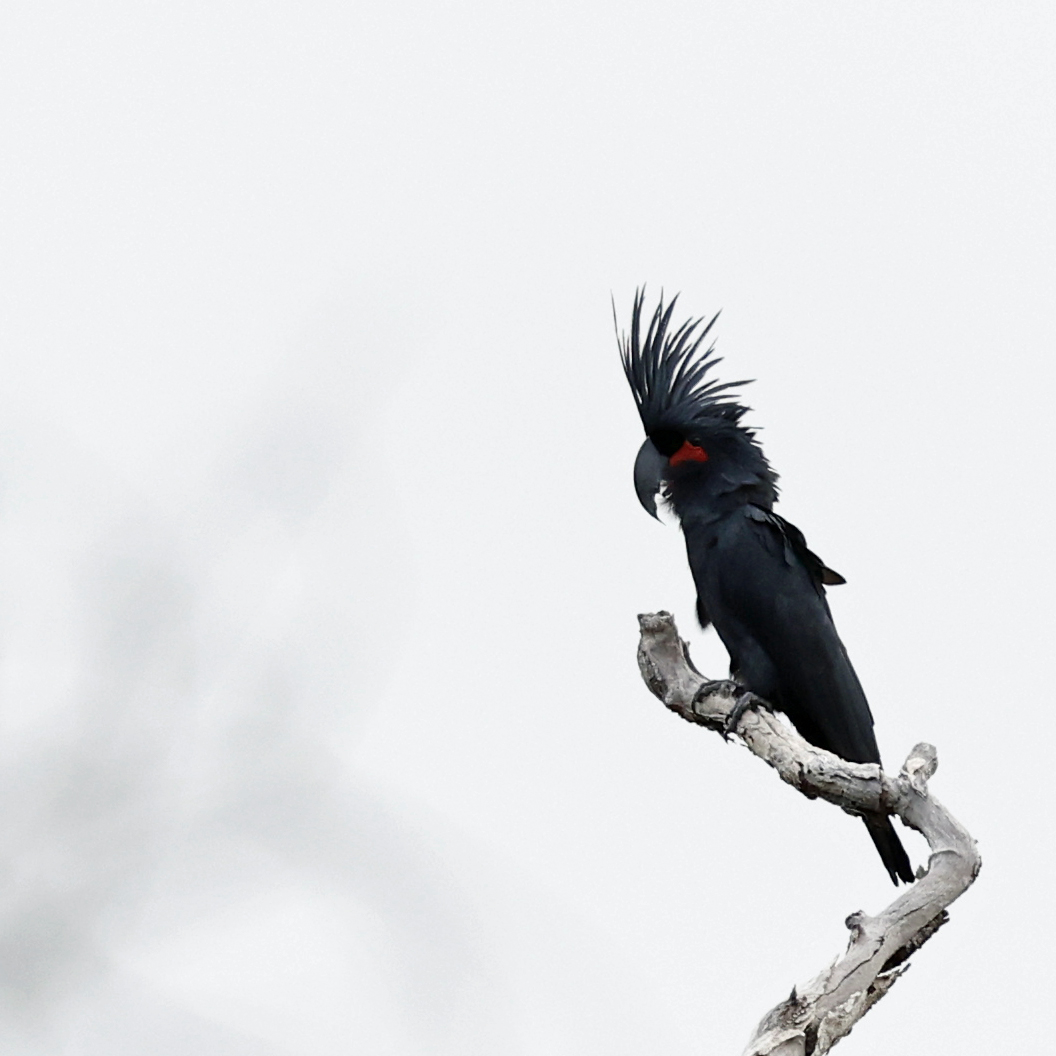
(Image copyright Birdwatching Tropical Australia)
I have posted this poem before, many years ago, however I just saw Palm Cockatoos in the flesh (or feather) for the first time up in Cape York. The male uses sticks to drum on hollow trees, something possibly unique among non-human creatures. (Although we do tend not to see, or hear, things that other species do.) My left shoulder boasts a tattoo of a Palm cockatoo; over ten years since that was inked I saw one.
The photo is of the one we got a good look at; I also saw a couple in flight. We saw Golden-shouldered parrots on the way up, an equally special bird that nests in termite mounds. It is unfortunately one of Australia’s most endangered birds.
The next bird I really want to see is more common. The budgie (the wild one) has always evaded me. I’d love to see a large flock of them in the wild. Occasionally one is seen in Canberra, but they are escapees from aviaries, given away by size and colour, probably wondering where all the seed went.
Tuesday poem: [haiku]
August 23, 2023
deep Dickensian dark
angler fish holds a lamp —
Please Sir, I want more light

PS Cottier
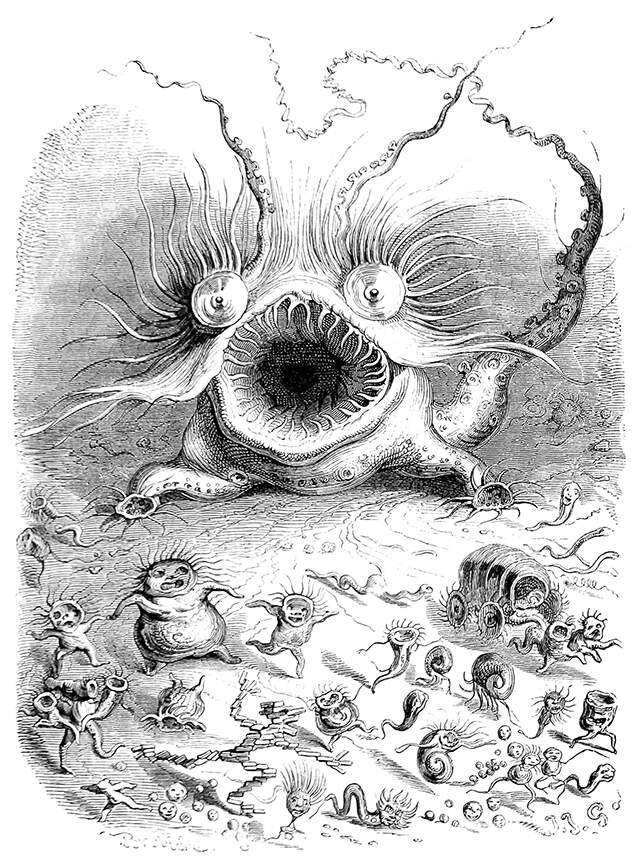
That’s not really an angler fish, but it’s such a great illustration by J-J Grandville that I had to use it.
 PS Cottier