Poetry wanted for new anthology: guidelines
February 25, 2013
The Stars Like Sand: Australian Speculative Poetry – Call for Submissions
Here are the detailed submission guidelines for the anthology I am editing with Tim Jones. Can’t wait to be reading the submissions after they close on June fourth. That gives you about three months, so pick up your quill or iPad and start writing, and/or rummage through your vast collection of previously published speculative poetry, and send some in to us, dear Australian poets!
THE ANTHOLOGY
The Stars Like Sand is a planned anthology of Australian speculative poetry. Speculative poetry is poetry in the science fiction, fantasy, horror and related genres. (Please see below for a fuller definition.) It is intended that the anthology will include both new and previously-published poetry, and include a historical survey of the field. The anthology is intended for publication in 2014.
The anthology will be published by IP (Interactive Publications Pty Ltd) of Brisbane, a leading Australian poetry publisher. IP previously published Voyagers: Science Fiction Poetry from New Zealand in 2009 Further information about IP is below.
The editors are New Zealand poet Tim Jones, who co-edited Voyagers, and Australian poet P. S. Cottier. Please see the editor bios below.
SUBMISSION GUIDELINES
Please note: Submissions do that not follow the guidelines below are unlikely be successful. In particular, attachments will not be read.
1) Submissions are now open. Please submit your poem(s) by midnight on date 04/06/2013. Any submissions received after the editors check their email the following morning will not be considered.
Submission format
2) Send no more than three (3) poems in an email message to starslikesand@gmail.com with the subject line “Submission to The Stars Like Sand”.
If you submit more than three poems, whether in one message or in separate messages, we will read only the first three you submit. You are welcome to send fewer than three poems.
3) Include your poem(s) in the body of your email message. Do not send attachments. Attachments will be not be read.
If your poem has special formatting requirements which cannot be reproduced in the body of an email, please send it anyway within the body of your email, but include a note about the formatting requirements. If necessary, we will get back to you to request a copy in the correct format.
4) Due to space limitations, we prefer to be sent poems of 50 lines or less. While we will still read longer submissions, they will have to be exceptional to be included. There is no lower limit on lines, so you are welcome to send haiku and other short forms, provided you send no more than three poems in total.
5) You are welcome to submit both unpublished and previously-published poems:
a) Unpublished poems: Unpublished poems selected for inclusion will be eligible for the Rhysling Awards: see http://www.sfpoetry.com/rhysling.html
b) Previously-published poems: Please supply full details of previous publication, including online, magazine and book publication. If permission is required from a publisher for your poem to be reprinted, we will ask you for the publisher’s contact details, and for your help with securing permission to reprint the poem in “The Stars Like Sand” should your poem be selected for inclusion.
6) If you are unsure what speculative poetry is, please see the notes below. If you are still not sure whether your poem fits, please send it anyway – we would rather read some poems that don’t fit than miss out on good but “borderline” poems.
7) After your poem(s), please include a biography of no more than 100 words in the body of your email message. Your biography may be edited for reasons of space.
Responding to submissions
8) We will respond to all submissions as quickly as possible. However, the time taken to respond depends on the volume of submissions received. Please be aware that, due to size limitations on the anthology, many submitted poems of merit will, unfortunately, have to be rejected.
9) Previous experience suggests that we are unlikely to be able to include all the previously-published poems we initially select for inclusion, due to difficulties obtaining reprint permissions. Should this occur, we may return to some poems that we were unable to include in our initial selection and ask the poets whether we can now include these poems in the anthology. We will do this only as and when necessary, so please do not resubmit poems which were initially rejected, or submit new poems, unless we ask you to.
Payment
10) All poets included, or their estates in the case of deceased poets, will receive a free copy of the anthology. There will no monetary payment for included poems.
Who can submit?
11) Residents of Australia, and Australians not currently resident in Australia, are eligible to submit. If you are unsure whether you are eligible to submit, please include a note in your email submission letting us know your situation.
WHAT IS SPECULATIVE POETRY?
Speculative poetry is poetry that falls within the genres of science fiction, fantasy, and horror, plus some related genres such as magic realism, metafiction, and fabulation. It is not easy to give precise definitions, partly because many of these genres are framed in term of fiction rather than poetry.
A good starting point is “”About Science Fiction Poetry” by Suzette Haden Elgin, the founder of the Science Fiction Poetry Association, which you can read here: http://www.sfwa.org/members/elgin/SFPoetry.html
Despite its title, this article is applicable to all forms of speculative poetry.
ABOUT THE EDITORS
Tim Jones
Tim Jones is a New Zealand poet and author of both literary fiction and science fiction who was awarded the New Zealand Society of Authors Janet Frame Memorial Award for Literature in 2010.
Among his recent books are a fantasy novel Anarya’s Secret (RedBrick, 2007), short story collection Transported (Vintage, 2008), and poetry anthology Voyagers: Science Fiction Poetry from New Zealand (Interactive Press, 2009), co-edited with Mark Pirie. Voyagers won the “Best Collected Work” category in the 2010 Sir Julius Vogel Awards. Tim’s third poetry collection, Men Briefly Explained, was published by IP in late 2011.
Tim’s poem “The Translator” appeared in Best New Zealand Poems 2004, and his short fiction has appeared in, among many other venues, Best New Zealand Fiction 4 (2007), and The Penguin Book of Contemporary New Zealand Short Stories (2009). His short story “The New Neighbours” was included in The Apex Book of World SF, Volume 2 (2012).
In 2011, Tim edited a special issue of the Science Fiction Poetry Association’s online journal Eye to the Telescope, devoted to speculative poetry by Australian and New Zealand poets.
P. S. Cottier
P.S. Cottier’s third poetry collection is the suite of poems “Selection Criteria for Death”, published in Triptych Poets Issue Three, Blemish Books in 2012. She has shared the David Campbell Award, given for the best unpublished poem by an ACT region writer. Her prose poem “Pod, cast”, originally awarded first place in a US science fiction competition in 2008, was included in The Indigo Book of Australian Prose Poems (2011). Penelope has had many fantasy and science fiction poems published in non-genre journals and newspapers, such as The Canberra Times and Eureka Street.
Penelope is also widely published in speculative journals in Australia and elsewhere, such as Star*Line (US) and Chiaroscuro: Treatments of Light and Shade in words (Canada). Her poem “Fingernails” was recently nominated for the Rhysling Awards, and her magic realist poem “Eight things you may not know about Vladimir Putin’s dog” was included in the inaugural Australian Poetry members’ anthology.
She wrote her PhD in literature at the Australian National University.
ABOUT IP
Interactive Publications Pty Ltd has been in business since 1994 and has been growing steadily since then. IP currently publishes 35+ titles per year, and is the second largest publisher of literary titles in Queensland.
Interactive Press is one of four imprints of IP. Interactive Press is one of the leading poetry imprints in Australia, publishing up to eight titles each year. Interactive Press titles are generally released via conventional print, as well as in print on demand (POD) and various eBook formats for outlets such as Amazon, Apple, Google, Kobo, Overdrive, eBooks Corp and Wheelers, making them accessible to audiences world-wide.
IP’s publisher is Dr David Reiter, himself a prize-winning poet and author.
Review (your fingers are getting twitchy)
December 20, 2012
Here’s a link to a new review of Triptych Poets Issue Three: http://verityla.com/peaks-from-start-to-finish-blemish-books-triptych-poets-issue-three/ in Verity La, an Australian journal. Tim Jones also reviewed the book previously, on his blog. Way back in November.
Spoiler alert: Mark William Jackson likes it!

Now, it may be just a tad late to stuff it into someone’s stocking in a Christmas related capacity, but why not make your New Year’s Resolution to read more poetry? I intend to read only poetry next year. But that’s just me. I’ll be boring on about that soon. In the meantime, your fingers are moving towards this link. They will press it. You will find that they are delving into your purse or wallet, and extracting your credit card. Somehow, your pesky digits enter your number. And in a while, the book will arrive, with three poets for the price of one. You will kiss your wise fingers, and run out to buy them gloves (should it be cold where you are), or to have a manicure (if, like me, you are a tad vain).
But you will thank your prescient fingers, again and again, as you read the book which Mark William Jackson describes as ‘just straight peaks from start to finish.’
I’m blushing as I paste in that quote, but modesty, they say, is a virtue. So it’s good to parade it.
Christmas. Good. Have.
Busy-ness unbefitting a poet
December 1, 2012
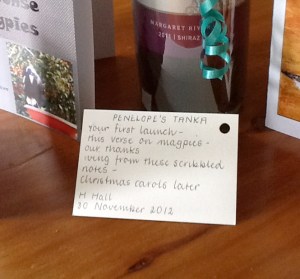
What a lovely present for a launch speech! Yesterday it was about 36 degrees in Canberra and unusually steamy, and I gave my first launch speech for the pamphlet In Response to Magpies. This was organised by Hazel Hall, Australian Poetry’s café poet at Biginelli’s café.
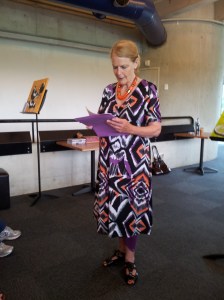
Hazel Hall
It went quite well, and the readings by the poets included in the collection were enjoyable. Here I am looking up in the air, as if there is an invisible magpie swooping:

Fortunately I am wearing my special invisible helmet
I am hoping to write up the speech for publication. The wine remains intact, as it is gin weather.
Last night I went to a poetry slam, co-organised by fellow Triptych poet J.C. Inman at The Front, and it was so steamy and hot we were all like pieces of tofu floating in a laksa. Here is a piece of poetic tofu, also known as J.C. Inman:
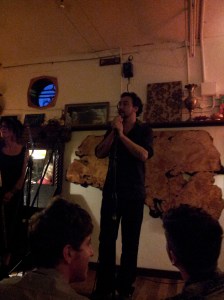
J.C. Inman
(my phone was fainting from the heat)
I realised how exhausted I was when I read a poem before the slam and my hands were literally shaking. People must have thought I was a very sensitive flower, but that was not it at all. It was: half heat, half gin, half gym. So what? A mathematican I ain’t.
Canberra: freezing one day and Brisbane the next. If only I could afford a pankawallah. Or another gin.
Now I’m off to be languid. After the gym.
Tuesday poem: Silver-eyes and figs
November 26, 2012
Silver-eyes and figs
Each bird a single note, played
between the heavy figs, swollen
breves in this flighted music,
swing accents in an airy score.
The eye does not dissect
any swift segue of feather,
rather the bird breeze shakes
the hand-leaves, palms turned away.
It is the movement we see, not
a display case specimen mounted,
spread eagled for our slower eyes.
To watch this quick-silver is to
turn away from focus, to become
silver-eyed ourselves, as the ruffled
feathers of the fig
breathe scent of bird.
This uncharacteristic poem appears in my first book, The Glass Violin, copies of which are still available from Ginninderra Press. (Scroll down this linked page to Cottier.) Annoyingly, the last two lines above should appear as a broken line, with the word ‘breathe’ under the word ‘fig’, but this broken line keeps being removed before I can post this entry, creating a lovely chunky effect. Sigh.
I still remember how nervous I was before the launch of that first book. Geoff Page did the launch speech.
And now I am doing the launch of a book for the first time on Friday. The book is called In response to magpies, and is a small pamphlet of nine poems dealing with this charismatic Australian bird. The idea is that it would make a wonderful alternative to a mere Christmas card. The authors are Denise Burton, Amelia Fielden, Hazel Hall, Norma Hayman, Kathy Kituai, Sandra McGahy, Fiona McIlroy, Sandra Renew and Jill Sutton.

golden eye, not silver
Details: Biginelli Expresso, 5th floor, School of Music, Australian National University, 2pm. Please come along if you feel like poetry or coffee (or both) in the middle of the day.
I understand that magpies cause some havoc in New Zealand, where they are an introduced species. So even though one might say Quardle oodle ardle wardle doodle, I doubt somehow that this feather represents the magpie. Click it, and you will fly to New Zealand, where further poetry awaits you.

Über-cool journal makes inexplicable mistake
October 4, 2012
Verity La, a rather stylish and influential on-line journal, has just published an interview with me, conducted by Duncan Felton. I deal with wonders such as buried cars and elephants’ testicles, inter alia. Why not go and have a read?
Also, in my Napoleonic campaign to take over the blogosphere, I have just had four poems published in Eureka Street. Marvel at tales of Albanian bowels, Julia Gillard’s shoe, discarded rubbish and strong language. Comments are always welcome there, too.

First Verity La, tomorrow the world…
 PS Cottier