Poem: A further squalid thing
January 16, 2026
The spaces between dog’s toes
are gardens of smell
erupting fungus tickles the nose
with a soupçon of shit.
She stores a safe of comfort there
and sniffs the spaces
to remind her of the day, the week,
perhaps the fragrant year.
Her brain is a sommelier’s,
sensing the slightest hint of dead bird,
the one at the street corner,
and comparing it with the cockatoo
whose carcass she pranced through the park.
The mixture of these avian scents
must be a kind of heaven, a menu
of brown and must, tucked between
those neat non-books of toe.
The title refers to Sei Shōnagon The Pillow Book, the section called Squalid Things. Poem first published Womens Ink!, November 2024
Budgies and shortlisting
October 1, 2024
Budgerigar

Ten million green commas punctuate blue sky,
quick breaths of swooping wonder, multiplied.
Water-hole is your target; liquid rope pulls you down
and the whole emerald sky is falling, diving,
as miniature bodies scoop into pool.
Your individual markings have taken you
further than native flight; outside the Louvre
I saw you, cold, trying to break in, as pointillist
as Pissarro but acrylic in your finish.
A proud but damp escapee from French balcony,
regretting the lost seed and the found liberty.
So plump and fresh, I have heard you were good eating,
a winging fast food charred to a turn;
as far from stringy battery chook as fingers in the fire.
Most know you singly; whistling in cages,
bowing and bobbing, rattling plastic mirrors.
Driven mad you ring and ring chink-chinky bells
or make love to that hard, hard-to-get reflection.
What joy to see you
just once, as you swoop,
one stitch amongst the tapestry,
a blade of grass in feathered turf carpet, magically landing,
transforming dreary waterside with that fallen sward of Eire.
Swift dragon of twenty million wings,
fluorescing with your simple, beak-filled joys.

PS Cottier

I have just returned from Boulia, in Queensland, about 300 km from Mount Isa, where I finally saw budgies in the wild. These have been my main target bird for ages, but they’ve always avoided me. We also saw wild cockatiels, which was wonderful.
***
In less ornithological news, I have two works shortlisted in separate national competitions. Firstly, my book Tuesday’s Child is Full (In Case of Emergency Press) is shortlisted for the Society of Women Writers (NSW) Book Awards for Poetry. This one is announced at a ceremony Sydney in late November.
Secondly, The Thirty-One Legs of Vladimir Putin, a novella manuscript co-written with NG Hartland, has been shortlisted for the 20/40 prize, run by publishers Finlay Lloyd. The main prize for this one is publication, so it will be a very exciting announcement later this month.
Tuesday poem: Orange-bellied parrots 2123
November 28, 2023
Orange-bellied parrots, 2123
Neophema chrysogaster

They are bigger than budgerigars,
but have never been as numerous.
A scant handful survived in 2023,
and smart orange bellies seemed
to be flashing a caution, a more-than-amber
pause, about to fall into a red stop, forever.

How many birds must there be
for an official murmuration?
We don’t know, but just yesterday,
we counted one hundred or more,
here, at Warn Marin/Western Port.
The shrubs whistled as if brave cicadas,
had flown over Bass Strait, not these
brilliant, blue-browed, blue-winged birds.
Their song was almost lost to the air’s ear.
Now we can vouch for its weirdness.

The heath has not felt beaks
tearing off so much fruit for years.
Tree hollows must be back way down South,
(or a thousand hand-crafted boxes)
just enough for breeding, enough for
a murmur, if not a murmuration.
They don’t move en masse, though, it must be noted,
but improvise, jazzy, in ones and threes.

They light up the bushes like Christmas lights,
the bellies seen, then hidden in green-grey leaves,
switched on and off by foraging.
We hear that some have been seen
as far North as Sydney. That may be a rumour,
a hopeful mistake, and yet, we saw one hundred.

How many make a murmuration?

PS Cottier

Parrots don’t form murmurations, like starlings, for example. (Perhaps budgies do? I have never seen them in the wild.) I was lucky enough to see a murmuration of native metallic starlings in Far North Queensland recently. But I like the idea of seeing enough of such a rare bird as the Orange-bellied parrot to even think of the word ‘murmuration’ in regard to them. Will they still be around in 100 years? I hope so, and that is what this unusually optimistic poem (for me) envisages.
And as we move towards Christmas, there’s a passing reference to that season here.
Tuesday poem: Palm cockatoo
October 9, 2023
Palm cockatoo

Heads like a child's drawing of bird heads,
huge beak and feather mane, flopping,
last extant beat-poet, croaking of things
hep and cool.  Man, you hit bedrock
on that arching drum, selecting the sticks
that give the deepest echo, sound playing
through that tall wooden amplifier,
from dark roots to hazy blowing sky.
You contemplate the waving tops
of tropical trees, plumed angel-head,
stylish in your deep black daytime rhythm.
Inimitable pulsing punctuation,
beaky accent perched above
the forest's bright green flow.
PS Cottier
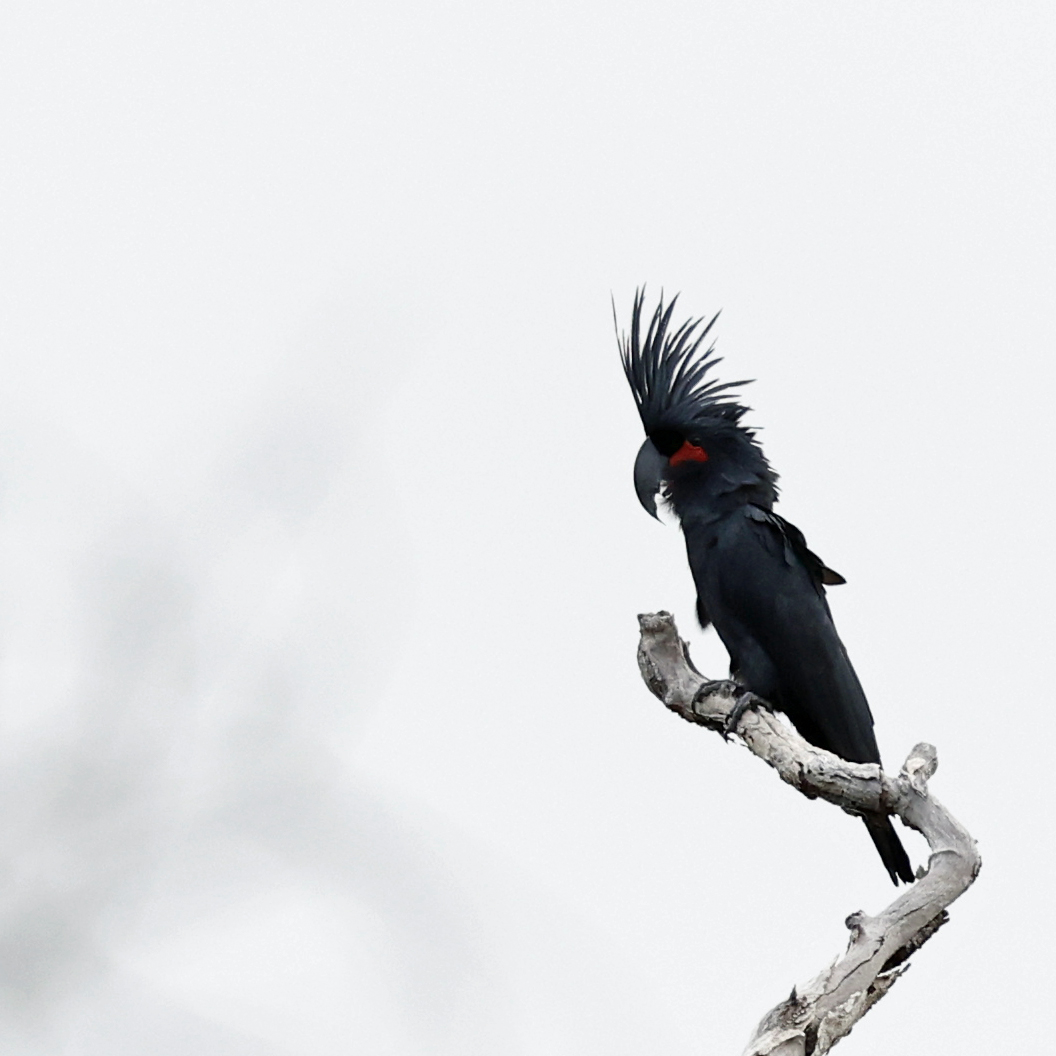
(Image copyright Birdwatching Tropical Australia)
I have posted this poem before, many years ago, however I just saw Palm Cockatoos in the flesh (or feather) for the first time up in Cape York. The male uses sticks to drum on hollow trees, something possibly unique among non-human creatures. (Although we do tend not to see, or hear, things that other species do.) My left shoulder boasts a tattoo of a Palm cockatoo; over ten years since that was inked I saw one.
The photo is of the one we got a good look at; I also saw a couple in flight. We saw Golden-shouldered parrots on the way up, an equally special bird that nests in termite mounds. It is unfortunately one of Australia’s most endangered birds.
The next bird I really want to see is more common. The budgie (the wild one) has always evaded me. I’d love to see a large flock of them in the wild. Occasionally one is seen in Canberra, but they are escapees from aviaries, given away by size and colour, probably wondering where all the seed went.
Tuesday poem: How Canberra
May 22, 2023
How Canberra
Parking at the AIS, pink imps called to me, or rather, grey imps wearing pink floppy hats. Gang-gangs opening gates in the sky. Walked to the pool, touching the bronze Guy Boyd woman poised on a plinth, the magic saint of all bad swimmers. Crawled through my twenty laps, more snail-stroke than free-style. Back to the car past groups of kids, past a well-known former athlete, past the memory of Covid marked by a discarded mask. Coffee at Tilley’s and more cockatoos, swinging below powerlines like avian punchlines, yellow fringes tickling the clouds.
PS Cottier

So a little translation for those who don’t live in Canberra; the AIS is the Australian Institute of Sport. Tilley’s is a venerable cafe in Lyneham, a suburb in the inner north of Canberra. And gang-gangs are a type of cockatoo. They are the faunal emblem of the Australian Capital Territory. An absolutely beautiful bird which can be seen quite frequently in Canberra, but which are overall becoming quite rare. Unlike the cocky in the photo.
 PS Cottier